
Greystone

Hardscape Foundations · Houston, TX

Paver Patios in Houston, TX

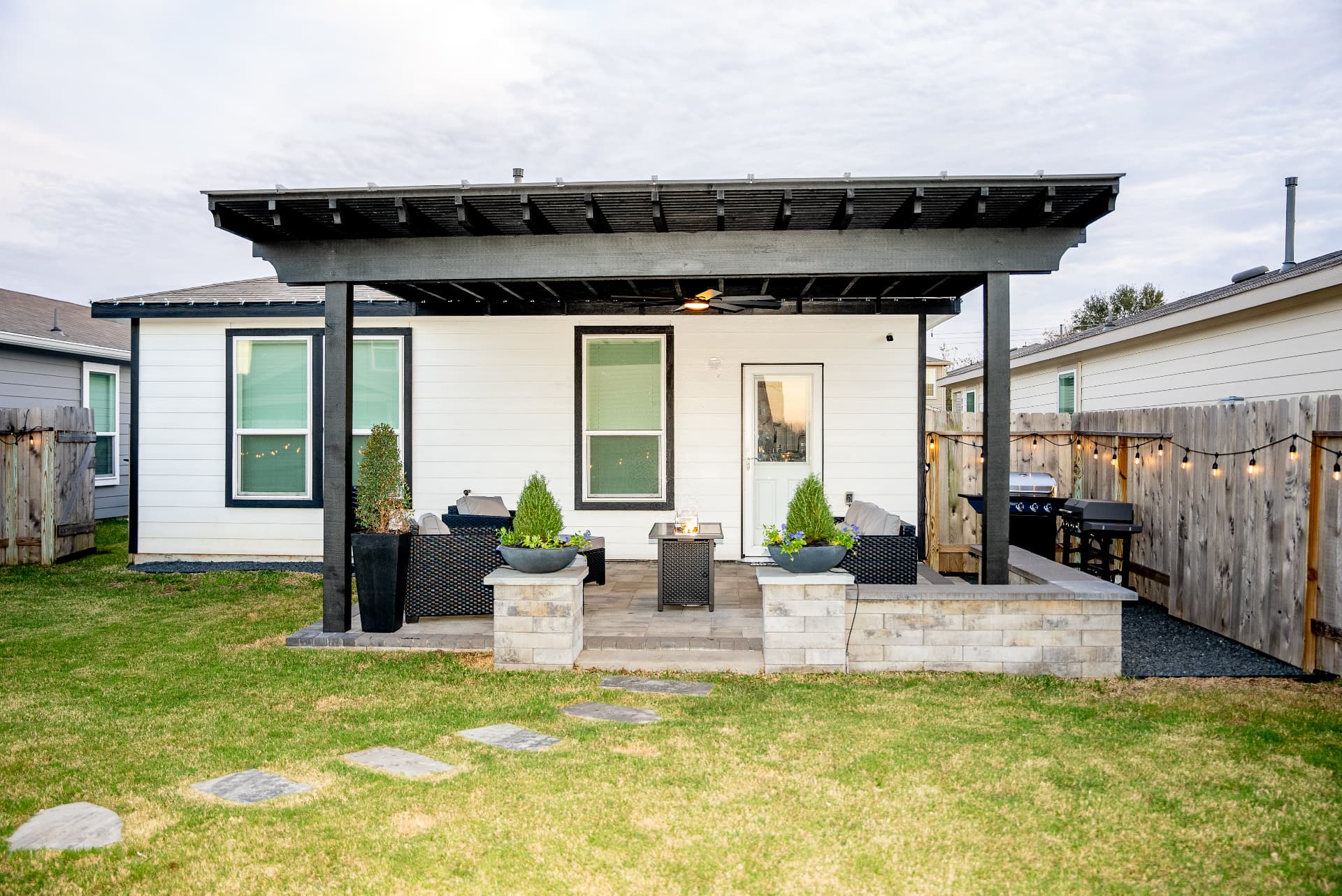
Inside the Loop, a paver patio is a drainage decision before it is a design decision. Houston lots sit dead flat, the soil under them is expansive gumbo clay, and in older sections the storm system was laid out for a street of 1,400-square-foot bungalows rather than the additions and second driveways those lots carry now. Add a canopy of live oaks whose roots run wherever the moisture is, and the patio you can actually build gets defined by what the site will tolerate. Greystone Landscapes has installed hardscape across Greater Houston since 2005. What follows is how we approach paver work on a city lot: base construction, root-aware layouts, permeable systems, deed restrictions, and honest numbers.

(281) 235-9143

Why here

Why paver patios make sense in Houston

In Houston, where outdoor living is a year-round priority, a quality paver patio is the foundation everything else is built around. Major metropolitan properties with professional paver work consistently command higher resale prices and attract more buyer interest than those without.

01

Inner-Loop Lots Change the Math on a Patio

A patio adds impervious surface, and on a 5,000-square-foot lot in Woodland Heights or Rice Military that already carries a house, a driveway, a walkway, and often a garage apartment, another 400 square feet of hard surface is no rounding error. Water that used to soak into St. Augustine has to go somewhere. We walk the lot after a rain whenever the schedule allows, find where sheet flow currently leaves the property, and shape the patio to keep that path open instead of damming it.

The constraint usually shows up as geometry. Rather than one wide rectangle pinned against the back fence, inner-loop projects often work better as a main terrace off the back door joined to a secondary zone by a narrower walk, with a gravel-set border where water needs to keep moving. We hold a consistent fall away from the house — a quarter inch per foot on most installs — and run it to a swale, a trench drain, or area drains piped to a solid line, so the yard is not relying on luck and a low spot in the fence. Access matters too: plenty of older lots have a 30-inch side gate or a gas meter in the pinch point, which means pallets get broken down at the curb and every ton of base rock moves by wheelbarrow. We price hand-haul conditions in the proposal rather than discovering them on day two.

02

Gumbo Clay Is Where Cheap Installs Come Apart

Houston's clay swells when it is wet and shrinks hard when it is not, and a summer drought followed by a wet fall moves the ground under a patio measurably. Pavers handle that better than a poured slab, because a segmental surface flexes at the joints instead of cracking across the middle. That only holds, though, if the layer between the clay and the pavers is built to carry load and shed water.

Our standard build excavates well below finished grade, lays woven geotextile directly on the subgrade so clay fines cannot pump up into the rock, then places crushed base in three-to-four-inch lifts, each compacted before the next goes down. Above that sits roughly an inch of coarse bedding sand, screeded flat and never compacted before laying. Depth varies with the site — deeper where the subgrade is soft, deeper still where an outdoor kitchen will sit on it.

When a homeowner shows us a four-year-old patio with ruts, birdbaths, and weed-choked joints, the cause is nearly always the same: sand dumped straight onto clay, no separation fabric, no compaction in lifts. It looked identical to a correct install the day it was finished. So the most useful question to ask any bidder in this city is how many inches of compacted base they are quoting and whether fabric is included.

03

Laying Out Around Live Oak and Pecan Roots

A mature live oak is often the most valuable thing on a Houston lot, and the feeder roots keeping it alive sit in the top foot of soil, spreading well past the drip line. Excavating eight or ten inches across that zone with a skid steer will not kill the tree that week; it kills it over the next three or four summers. On treed lots we map the canopy first and treat the critical root zone as a fixed obstacle.

The practical moves are straightforward. We hand-excavate inside the root zone, cut only what is small and unavoidable, and where depth would mean real root loss we build up rather than down, floating the patio slightly above existing grade and blending it out with a low seat wall. That flexibility is the strongest argument for pavers over concrete on an old Houston lot: ten years from now, when a root has lifted a corner an inch, the fix is pulling forty pavers, adjusting the base, and resetting them in an afternoon. The same movement in a slab means a saw, a jackhammer, and a color match that never quite matches.

04

Permeable Systems and When They Earn Their Cost

A permeable paver system looks like a normal patio and works nothing like one. The pavers sit on open-graded stone, the joints are filled with small chip rather than fine sand, and rainfall passes through the surface into a stone reservoir that holds it and releases it slowly. Where every downspout and every new square foot of hardscape already competes for the same outfall, that reservoir buys capacity nothing else will.

We specify it most often in three situations: lots with no good place to discharge, side yards that turn into a mud channel every spring, and rear patios where the neighboring property sits lower. Because our clay infiltrates poorly, these usually get a perforated underdrain in the reservoir — the stone still buffers the storm even when the ground will not take it.

The trade is cost and upkeep. Permeable construction runs a premium over a conventional build — deeper excavation, more expensive aggregates — and the joints need vacuuming or blowing out periodically to stay open. For most backyards it is optional; for a lot with a real water problem it beats burying a detention solution under the lawn.

05

Deed Restrictions, Approvals, and the Neighbor Downhill

Houston has no zoning, but most established neighborhoods run on deed restrictions administered by a civic club, and plenty of them speak to lot coverage, rear setbacks, and what can go between the house and the side line. We pull the restrictions for your section before the design is final — relocating a terrace on paper costs nothing.

An at-grade patio by itself frequently falls outside what requires a building permit, while the things people attach to it — a shade structure, a gas line, electrical, or a change to how the lot drains — commonly do. Instead of quoting a threshold that may shift, we confirm with the Houston Permitting Center what your scope triggers before you sign, carry any fees in the contract, and file the paperwork ourselves.

The dispute we see far more often than a permit problem is a drainage complaint from next door. Houston lots sit close together and liability for redirecting water onto a neighbor is real. We shoot and photograph existing grades before demolition, design so post-construction flow matches or improves on what was there, and will walk the plan with an adjoining owner when the patio hugs a shared fence.

06

Material Choices for Heat, Rain, and Moving Ground

Concrete pavers are the default here for good reason: dimensionally consistent, available in enough formats to suit a 1930s bungalow or a new build, and forgiving of the seasonal movement our soil produces. Large-format planks read contemporary; tumbled and antiqued profiles sit better against older brick. All of them lift and reset, which is the property that matters most on a clay lot.

Travertine is the premium option Houston buyers ask for by name, mostly because it stays noticeably cooler underfoot in August than dense concrete. It suits pool surrounds and shaded terraces, costs more installed, and wants a penetrating sealer if it is going to shrug off tannin stains from an overhanging oak. Clay brick is the other authentic inner-Loop choice, particularly on Eastwood and Woodland Heights homes where the existing masonry sets the palette.

On sealing, our climate argues for a breathable penetrating product over a heavy gloss topcoat, which can cloud when moisture gets trapped beneath it. Renew the sealer periodically, top up joint sand every few seasons, and budget an occasional low-pressure wash. That is the whole maintenance program here.

07

Where the Money Goes on an Inner-Loop Patio

Standard concrete pavers, installed on a properly built base, land in the range of $14 to $25 per square foot in this market. At the size most inner-loop backyards support, a 300 to 500 square foot patio commonly totals $6,000 to $14,000. Travertine and premium natural stone move that per-foot figure into the $22 to $38 band, and a multi-zone hardscape with seat walls, steps, and a fire feature prices above all of it. We quote from a site visit, because those ranges assume nothing unusual underground.

The line items that most often push a Houston number upward are demolition and haul-off of an existing slab, corrective drainage tied into a real outfall, hand-haul access, and extensive curved or diagonal cuts. We itemize each so you can trade scope deliberately rather than guess at what a round number covers. And if a pergola, kitchen, or lighting is anywhere in your plans, say so now — sleeving conduit and gas under an open base costs very little; cutting a finished patio later costs many times that.

What you get

What Houston homeowners get

Wide selection of travertine, concrete, brick & natural stone

Engineered for Houston's expansive clay soil

Slip-resistant surfaces for pool and wet areas

Custom patterns, borders and inlays

Integrated drainage to prevent water pooling

Low maintenance and extremely durable

How it works

Your Houston project, step by step

01

Property assessment and drainage evaluation

02

Design, material selection & layout plan

03

Excavation and base preparation

04

Paver installation, sealing and cleanup

Paver Patios across Houston

Our crews work throughout Houston — including these neighborhoods and the surrounding area.

Woodland HeightsRice MilitaryMontroseEastwoodRiverside TerraceOak ForestMeyerlandWestburyIdylwoodSharpstown

Questions

Paver Patios questions from Houston homeowners

Paver Patios near Houston

More services in Houston

Popular pairings with paver patios: Pergolas, Outdoor Kitchens, Water Features.

Request a quote

Ready for paver patios at your Houston home?

Greystone Landscapes has designed and built outdoor spaces across Greater Houston since 2005. Get a free on-site consultation for your Houston project.

(281) 235-9143