
Greystone

Hardscape Foundations · Spring, TX

Paver Patios in Spring, TX

Most of the paver patio work we do in Spring is replacement work. The housing stock here filled in hard through the 1990s and early 2000s, and the backyards came with two things that have now reached the end of their lives: stamped concrete that has cracked and lost its color, and pressure-treated wood decks that have been rebuilt in pieces until nobody wants to rebuild them again. Add pine and oak roots lifting slabs from underneath and a generation of gunite pools whose decking is older than the current owners' children, and you get the project we are called for constantly in Klein and Spring: take out what failed, and build something that will not.

(281) 235-9143

Why here

Why paver patios make sense in Spring

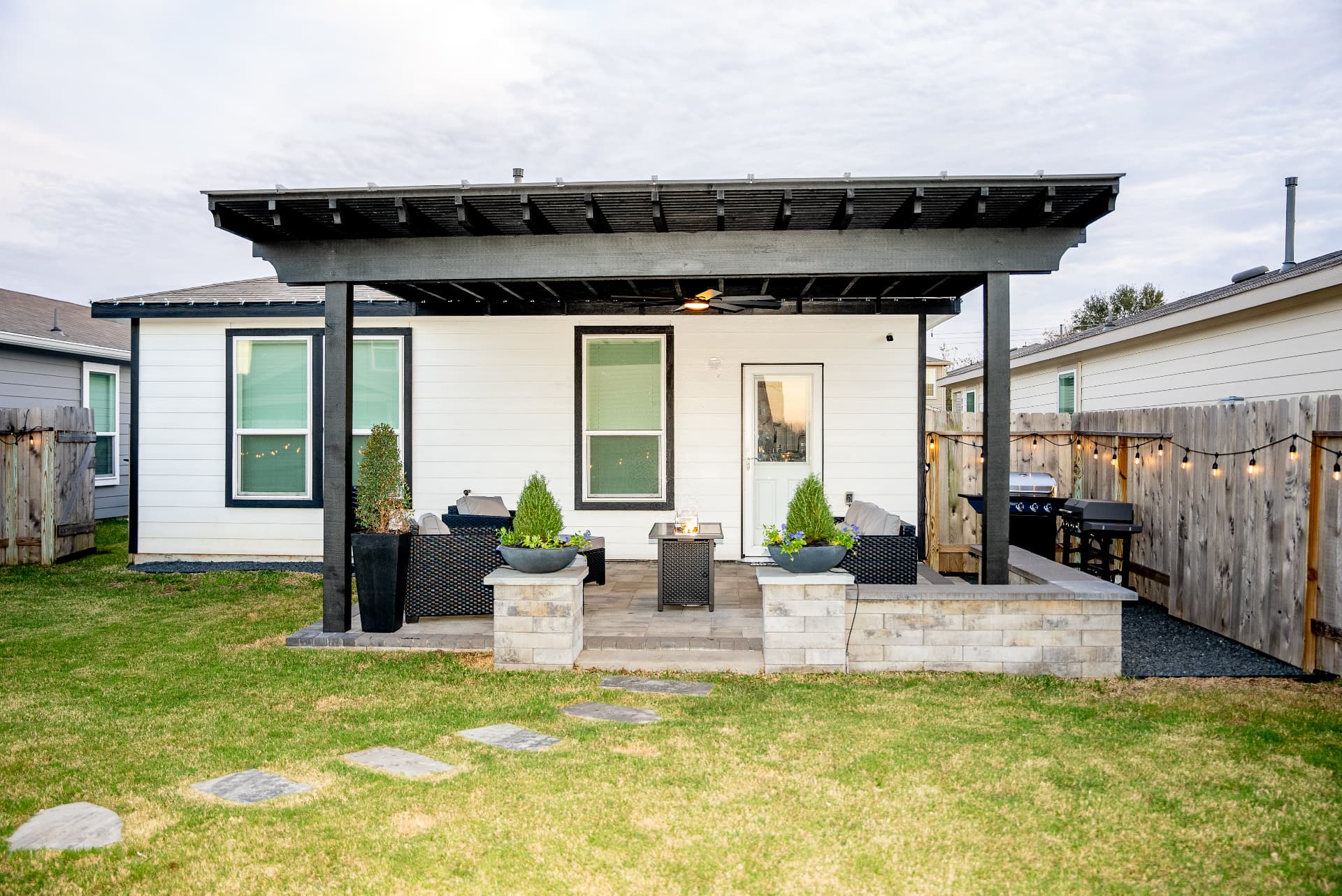
In Spring, where outdoor living is a year-round priority, a quality paver patio is the foundation everything else is built around. Established suburb properties with professional paver work consistently command higher resale prices and attract more buyer interest than those without.

01

Why the Backyards Here Are All Coming Due at Once

Stamped concrete was the premium patio product when these neighborhoods were built, and it has aged exactly the way a rigid slab ages over expansive clay. It cracks — usually right across the pattern, where a control joint was skipped because it would have interrupted the design. The integral color and release agent fade unevenly under thirty summers of ultraviolet. Homeowners re-stain it, which looks good for two seasons and then peels in the traffic lanes. There is no version of that maintenance cycle that ends well, because the underlying problem is a monolithic slab sitting on soil that moves.

The wood decks have a parallel story. A treated pine deck built over Houston humidity, with joists at ground level and no airflow beneath, gives you fifteen or twenty solid years and then starts telling you about it. Boards cup and splinter. Fasteners back out. The ledger board against the house is the piece that quietly worries us most, because that is where water gets behind the flashing and into framing you cannot see. By the time a deck feels bouncy underfoot, the repair estimate is usually within shouting distance of a full replacement.

Pavers appeal to people coming out of both experiences for the same structural reason. A paver field is a flexible pavement: many small units over a compacted aggregate base, with joints that let the whole assembly articulate slightly as the clay below swells and shrinks. Clay still moves under a paver patio. The difference is that a flexible surface accommodates the movement, and when a small area does go out of level, it lifts and re-sets in an afternoon instead of requiring a saw and a jackhammer.

02

Getting the Old Surface Out

Demolition is a real line on a Spring proposal, not a rounding error, and it is one of the reasons replacement projects here price differently than new construction on a bare lot. A four-inch reinforced slab with wire mesh has to be broken, cut around the house, loaded, and hauled. A deck has to be dismantled, the footings pulled, and the disturbed soil brought back to a compactable subgrade. We quote disposal by volume based on what we measure on the site visit rather than a guess, and we tell you up front if we suspect there is a second, older slab underneath — which in Spring there sometimes is.

We are occasionally asked whether we can lay pavers directly over the existing concrete and skip demolition. Sometimes we can. It requires a slab that is structurally sound, has no active differential cracking, and sits low enough that adding two or three inches of build-up will not put the finished surface above the door threshold or the house weep holes. When those conditions hold, an overlay saves real money. When they do not, we say so — putting a new surface over a slab that is still moving simply transfers the crack upward in about two years.

One thing we always check during teardown is where the old patio was sending its water. Builder-era slabs in this area were frequently poured flat or, worse, pitched slightly back toward the house. If your foundation has been taking patio runoff for two decades, replacement day is the right moment to fix it. We re-cut the subgrade to fall away from the structure and, when the yard beyond is flat, run a drain line from the low edge out to daylight while the ground is already open.

03

Roots, and What They Do to Flatwork

The wooded sections of Spring — the lots that kept their loblollies and water oaks when the subdivision went in — produce a specific failure we see constantly: a slab tilted at one corner, or a walkway with a two-inch step where a root ran beneath it. Roots thicken over decades, and concrete has no mechanism for accommodating that. It either cracks or it rides upward as a plate, and the crack shows up wherever the slab is weakest rather than where the root is.

When we rebuild that area, the design starts with understanding what is under it. We open the subgrade and look. If a major structural root crosses the patio, we do not simply cut it and pour on — severing a large anchoring root on a mature pine is a stability question as much as a health question. We route around it where the layout allows, or bridge it with a thicker open-graded base section and geogrid so the load spreads across a wider footprint and the root has somewhere to grow into.

The maintenance argument matters here too. Under a tree that is still growing, future movement is not a possibility, it is a schedule. On pavers that future arrives as a slightly high spot you fix by pulling twenty units and re-screeding. On concrete it means a saw cut and a patch that never matches.

04

Meeting a Twenty-Five-Year-Old Pool

A large share of Spring homes came with gunite pools, and those pools usually came with a Kool Deck or similarly troweled cool-deck surround that is now chalky, patched, and staining. Homeowners very often want the pool kept and the deck replaced, which is a more precise job than it sounds. The pool shell, the bond beam, and the coping are not ours to disturb, and the plumbing runs somewhere in the deck we are removing. We saw-cut clear of the beam, work by hand in the last band around it, and locate returns and skimmer lines before anything mechanical gets near them.

Coping is where the design decision lives. Existing cantilevered concrete coping can stay, with the new paver field brought up tight and flush beneath its lip, which is the least invasive and least expensive path. Or the coping comes off and gets replaced with bullnose paver or travertine coping, which is what most clients actually want visually once they see the two options side by side, since a fresh deck against tired original coping is exactly where the eye lands.

Around a pool we change the surface specification. Textured or tumbled pavers and honed travertine hold traction wet and stay cooler underfoot than a dense dark unit, which matters when the deck is in full afternoon sun in August. We keep the slope running away from the pool so deck water and its chemistry go to the yard rather than back into the water, and we set the jointing material with pool splash-out in mind rather than treating the pool deck like any other patio.

05

Approvals, Numbers, and Choosing Who Builds It

Spring is genuinely mixed on the approval question, and it surprises people. Master-planned communities like Gleannloch Farms and Augusta Pines run active architectural committees with submission forms and defined turnaround. Older unincorporated pockets a mile away have no active association at all, and the only real constraints are utility easements, drainage easements, and Harris County requirements that may attach depending on scope. We establish which situation your property is in before design goes final, prepare and file whatever packet your association wants when one exists, and confirm current county requirements for your specific scope while the proposal is being written.

On money: expect roughly $14 to $25 per square foot installed for standard concrete pavers in this market, which puts a typical 300 to 500 square foot patio in the $6,000 to $14,000 window. Travertine and premium natural stone run about $22 to $38 per square foot, and large multi-zone hardscape packages sit above these ranges entirely. Replacement projects then carry demolition and haul-off on top, and pool-deck work carries the extra hand labor around the beam. We show those as their own lines so you can see precisely what the teardown is costing you versus the new surface.

If you are collecting bids, three questions separate the field quickly. What base depth and compaction method are you using, and is there separation fabric over the clay? How is the perimeter restrained, and is it spiked into the base or just buried in soil? What is your written workmanship coverage, and what specifically voids it? A contractor who answers those three precisely will usually not be the cheapest number in the stack, and on a replacement patio in Spring the cheapest number is generally the one that gets replaced next.

What you get

What Spring homeowners get

Wide selection of travertine, concrete, brick & natural stone

Engineered for Houston's expansive clay soil

Slip-resistant surfaces for pool and wet areas

Custom patterns, borders and inlays

Integrated drainage to prevent water pooling

Low maintenance and extremely durable

How it works

Your Spring project, step by step

01

Property assessment and drainage evaluation

02

Design, material selection & layout plan

03

Excavation and base preparation

04

Paver installation, sealing and cleanup

Paver Patios across Spring

Our crews work throughout Spring — including these neighborhoods and the surrounding area.

Gleannloch FarmsAugusta PinesBenders LandingChampion ForestMemorial NorthwestNorthgate ForestSpring TrailsCypresswoodLegends Ranch

Questions

Paver Patios questions from Spring homeowners

Paver Patios near Spring

More services in Spring

Popular pairings with paver patios: Pergolas, Outdoor Kitchens, Water Features.

Request a quote

Ready for paver patios at your Spring home?

Greystone Landscapes has designed and built outdoor spaces across Greater Houston since 2005. Get a free on-site consultation for your Spring project.

(281) 235-9143