
Greystone

Hardscape Foundations · Pearland, TX

Paver Patios in Pearland, TX

Pearland is flat. Not gently rolling, not subtly graded — flat, over deep Beaumont clay that absorbs almost nothing, in a part of the region where a heavy summer cell can drop several inches in an afternoon. That single fact decides more about a Pearland paver patio than the paver you pick, the pattern you like, or the size of the space. If a patio here is designed as a surface first and drainage second, it becomes the low spot in your yard, and you will spend the next decade watching water sit on it. We design them the other way around, and this page explains what that actually involves.

(281) 235-9143

Why here

Why paver patios make sense in Pearland

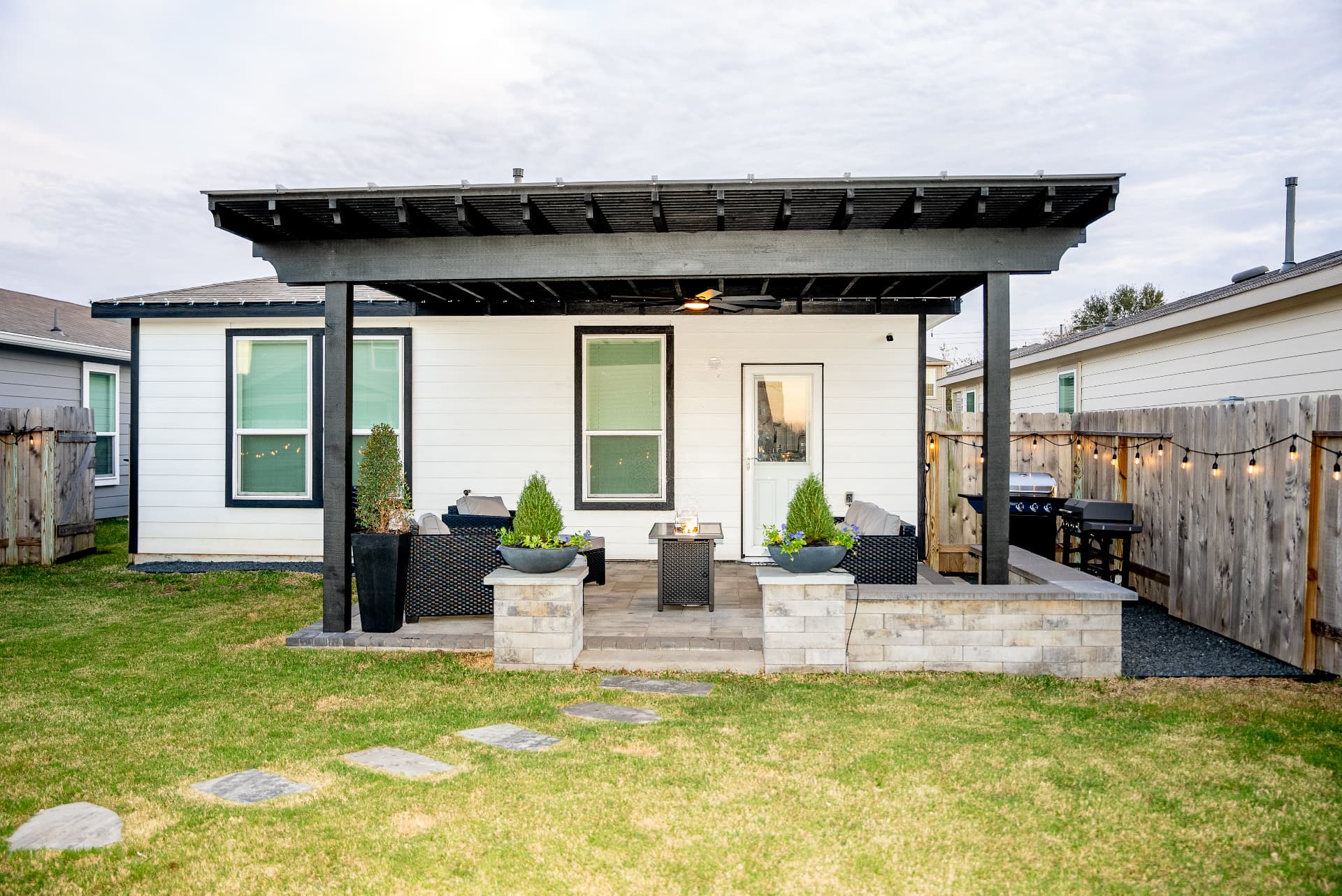
In Pearland, where outdoor living is a year-round priority, a quality paver patio is the foundation everything else is built around. Master-planned community properties with professional paver work consistently command higher resale prices and attract more buyer interest than those without.

01

Where the Water Goes Is the Whole Design

Beaumont clay does not percolate in any practical sense. Rain that falls on a Pearland lot leaves by moving across the surface or it does not leave at all, which is why so many backyards here hold sheet water for a day after a storm and stay spongy for two more. Drop a patio into the middle of that without changing the grade and you have created a shallow basin with a hard bottom.

So we survey before we sketch. We shoot elevations across the yard, find where water currently collects and where it wants to exit, and only then place the patio and set its finished elevation. Occasionally the answer is to raise the patio several inches above the surrounding lawn so it sheds in every direction and reads as a deliberate raised terrace with a step or a seat wall at the perimeter. That is not a decorative choice on a lot like this — it is the cheapest possible drainage solution.

Slope is non-negotiable and larger than most homeowners expect. We hold an eighth of an inch of fall per foot as an absolute floor and prefer more where the eye will not read it. Across a twenty-foot patio, that is a two-and-a-half-inch drop from the house to the far edge, and it is invisible when you are standing on it. Skip it and you will find out exactly where the flat spot is the first time it rains hard.

02

Drainage Systems We Actually Install Here

Sloping the surface is step one; the water still has to go somewhere. On a Pearland lot with no natural fall, that usually means a collection system. Channel drains set flush at the low edge of a patio catch sheet flow where a patio meets a lawn that cannot take it. Catch basins in the yard's low corners handle the ponding that predates your patio. Both tie into solid PVC — not corrugated flex pipe, which sags and silts on flat runs — carried to daylight at the lowest available point or to a curb outfall where the property allows it.

Where a lot is genuinely landlocked with nowhere to send water by gravity, the honest options are a dry well sized to buy detention time, a regraded swale routed along a side yard, or a sump-and-pump arrangement. We will tell you plainly which of those your property needs and what it costs before you commit to a patio, because discovering the problem after the pavers are down is the expensive sequence.

Permeable paver systems come up often in conversation here, and they are a legitimate tool with a specific caveat: their storage capacity is in the open-graded stone reservoir under them, not in the soil below, which will not take the water. Over Pearland clay, a permeable installation still needs an underdrain to carry stored water out. Built that way it works well and can meaningfully reduce what your yard has to absorb. Built without the underdrain, it is a bathtub.

03

West-Side Fill and East-Side Established Ground

There are effectively two Pearlands from a hardscape standpoint. The newer communities out west along the 288 corridor and around Shadow Creek Ranch were largely built on engineered fill brought in to raise the pads out of former prairie and rice ground. The older east side, in and around the original town and the neighborhoods off Broadway, sits on ground that has been settled for decades under native clay profiles.

Fill behaves differently, and we treat it differently. Younger fill can still be consolidating, and it is not always uniform across a lot, so we proof-roll and probe the subgrade before committing to a base section rather than assuming what is under the sod. Where fill is soft or variable, we go deeper on base, add geotextile separation, and often include geogrid to bridge inconsistent support. Skipping that step is how a two-year-old patio in a newer subdivision develops a dip nobody can explain.

The established east-side lots bring their own issues, mostly age-related: mature trees with roots through the work area, original clay-tile or early PVC utility lines at shallow depth, old slab patios poured directly on grade, and yard grading that has been altered three times by three owners. The base engineering there is more conventional, but the site investigation matters more. We locate what is buried before we dig rather than after.

04

The City, the Easements, and the Paperwork

Unlike the unincorporated county pockets elsewhere in our service map, Pearland runs a permitting department of its own, and that changes the process meaningfully. Whether a specific patio requires a permit depends on scope: an at-grade paver surface with no structure and no electrical is treated differently than a raised deck, a covered structure, or a project that alters drainage patterns or adds significant impervious cover. Requirements change, so we confirm what applies to your exact design with the city while we are preparing the proposal, and we price any permit cost into the contract rather than surprising you with it.

Drainage easements deserve their own mention in this city. Many Pearland subdivisions carry drainage or utility easements along rear and side property lines, and those exist so water and infrastructure have a legal path. Building a patio, wall, or footing inside one is a real problem — it can be ordered removed, and it can interfere with the very drainage your neighborhood depends on. We pull your plat and confirm easement locations before the design is finalized.

If your neighborhood has an active architectural committee, and most of the newer master-planned sections do, we assemble the review packet — layout, elevations, material and color selections — and file it for you. Older parts of the city often have no association at all, in which case the city and the plat are the only constraints in play.

05

Materials, and What This Costs in Pearland

Standard concrete pavers price out around $14 to $25 installed per square foot here; apply that to the footprint most Pearland families settle on, 300 to 500 square feet, and the total sits between $6,000 and $14,000. For travertine and premium natural stone, plan instead on roughly $22 to $38 a square foot. Layered hardscape packages that combine multiple zones, walls, and connecting paths sit above those brackets by their nature.

What moves a Pearland quote is almost always below the surface. Drainage work — channel drains, catch basins, buried line to an outfall, or a dry well — is its own scope with its own cost, and on a poorly draining lot it can approach the cost of the paving itself. Deeper base sections and geogrid over soft fill add material and labor. Removing an existing slab adds demolition and haul-off. We break each of those out so you can see what you are buying rather than reading one blended number.

On material selection, our climate does the choosing more than fashion does. Dense concrete pavers with low absorption hold up well in humidity and resist the surface biology that thrives here. Textured finishes keep their traction wet, which matters on a surface that will be wet often. Very dark units absorb enough summer heat to be unpleasant barefoot in July, so we generally steer clients toward mid-tone selections unless there is a strong design reason not to.

06

How to Read a Pearland Bid

The single most useful thing you can do with competing proposals here is check whether drainage appears at all. A bid that quotes square footage and paver style with no mention of slope, no elevation strategy, and no collection system on a flat clay lot is not a cheaper version of the same project — it is a different, worse project that will hold water.

Then look at the base description. You want to see a stated compacted depth, separation fabric between the clay subgrade and the aggregate, compaction in controlled lifts, and edge restraint spiked into the base rather than set in loose soil. Ask what the plan is if the subgrade proves soft when it is opened up, because on filled ground west of 288 that is a live possibility, and you want to know whether that triggers a change order or is already covered.

Finally, ask who is actually on site and who is accountable. One project lead stays with a job start to finish, from the initial walk of the site through the closing walkthrough, which means the person who measured your grade is the person answering for how it drains. Greystone Landscapes has been building across Greater Houston since 2005, and on flat clay the difference between a patio that ages well and one that does not is almost entirely in decisions made before the first paver is set.

What you get

What Pearland homeowners get

Wide selection of travertine, concrete, brick & natural stone

Engineered for Houston's expansive clay soil

Slip-resistant surfaces for pool and wet areas

Custom patterns, borders and inlays

Integrated drainage to prevent water pooling

Low maintenance and extremely durable

How it works

Your Pearland project, step by step

01

Property assessment and drainage evaluation

02

Design, material selection & layout plan

03

Excavation and base preparation

04

Paver installation, sealing and cleanup

Paver Patios across Pearland

Our crews work throughout Pearland — including these neighborhoods and the surrounding area.

Shadow Creek RanchSilverlakeSouthdownGreen Tee TerraceCountry PlaceRiverstone RanchPine HollowWest Oaks VillageMassey Oaks

Questions

Paver Patios questions from Pearland homeowners

Paver Patios near Pearland

More services in Pearland

Popular pairings with paver patios: Pergolas, Outdoor Kitchens, Water Features.

Request a quote

Ready for paver patios at your Pearland home?

Greystone Landscapes has designed and built outdoor spaces across Greater Houston since 2005. Get a free on-site consultation for your Pearland project.

(281) 235-9143