
Greystone

After-Dark Curb Appeal · Spring, TX

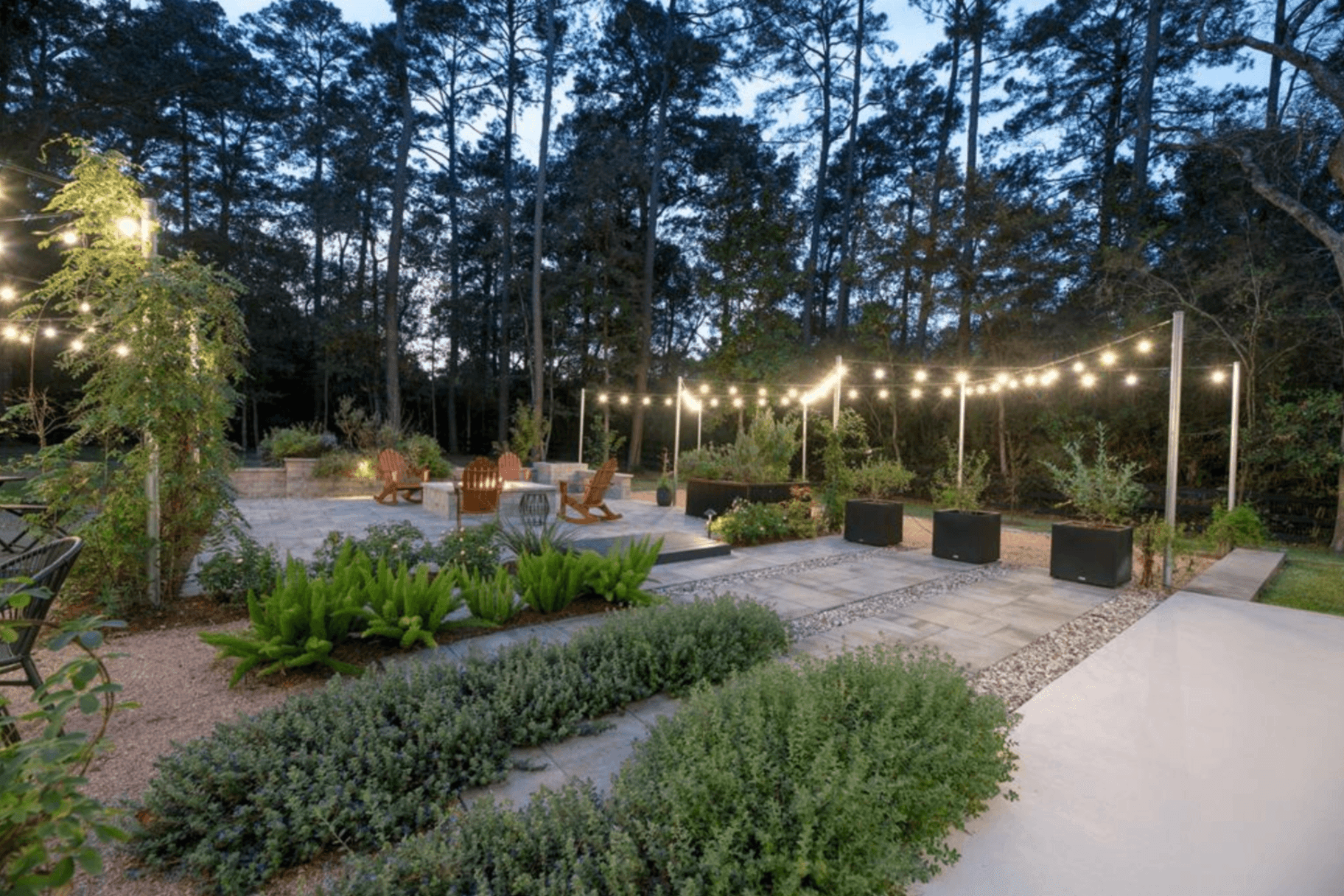
Landscape Lighting in Spring, TX

A large share of the lighting work we do in Spring is not a first installation — it is the second one. Gleannloch Farms, Champions, Northampton, and the older Klein and Louetta sections were built when low-voltage halogen was the standard, and those systems are now fifteen to twenty-five years old: lamps burning out every season, corroded splices, a transformer humming at its limit, and a handful of fixtures that simply stopped working and were quietly abandoned. Greystone Landscapes has worked north Harris County since 2005, and this page is about what is worth salvaging from a system like that, what is not, and what an LED conversion on a wooded Spring lot actually costs.

(281) 235-9143

Why here

Why landscape lighting make sense in Spring

Landscape lighting in Spring does more than look beautiful — it signals a well-maintained, premium property that stands out on the street. Established suburb homeowners who invest in professional lighting consistently see the impact in curb appeal, security, and the number of evening hours they actually use their outdoor spaces.

01

How an Aging Halogen System Fails

Halogen fixtures fail predictably, and Spring homeowners describe the same sequence to us over and over. Lamps that once lasted a couple of seasons start going monthly. The far end of a run dims noticeably. Water finds its way into a fixture body and the socket corrodes. Someone replaces a burned-out lamp with whatever wattage the hardware store had, which loads the circuit further, which shortens the life of the lamps still working. Eventually the yard is half-lit and nobody can say which problem came first.

The underlying arithmetic explains most of it. A halogen MR16 draws roughly twenty to thirty-five watts, so twelve of them approach the capacity of a common residential transformer. LED fixtures producing comparable usable light typically pull single-digit wattage. That difference is why a converted system runs cooler, holds voltage better across a long run, and leaves capacity for the fixtures a homeowner adds later — and why lamps stop being an annual expense.

Heat is the other quiet culprit. Halogen lamps run hot enough to degrade gaskets, socket contacts, and lens seals from the inside over the years, which is how moisture eventually gets in even on a well-built fixture. Two decades of that cycle in Gulf Coast humidity is why so many original Spring systems are failing at the fixture rather than in the wire.

02

Evaluating What Is Already in Your Ground

Before we quote anything, we test the existing system rather than assume it needs to go. We check cable gauge and insulation condition where it is accessible, measure voltage at each fixture location to find the runs that are overloaded or compromised, open representative connections to see how they were made, and read the transformer's rating against what is actually connected to it. That inspection is what determines whether you are buying a conversion or a replacement.

Buried cable is frequently the good news. Direct-burial conductor of adequate gauge with intact insulation regularly survives twenty years underground in perfect working order, and reusing it means no trenching through beds and root zones that have matured around it. That single finding is the difference between a disruptive project and a two-day one, and it is why we never quote a retrofit sight unseen.

What rarely survives is everything else. Splices made with wire nuts and electrical tape corrode green in this soil; fixture housings from that era are usually aluminum or plastic that has grown brittle; and a transformer sized for halogen load is often both undersized in capacity and past the age where its components are trustworthy. Our normal recommendation is keep the wire where it tests sound, replace fixtures, connectors, and transformer outright.

03

Wooded Golf-Course Lots and Where the Light Should Go

Spring's golf communities left a lot of trees standing, and homes in Gleannloch Farms, Champions, and Augusta Pines commonly sit on lots with mature pines and oaks plus frontage on a fairway or a greenbelt. That backdrop changes the layout. Light aimed toward open course property serves nothing and carries a long way at night, so the rear of these lots is where we pull back — a few low, fully shielded fixtures on the patio and steps, and the tree work aimed inward toward the house.

The front is where the original halogen layout most often needs rethinking rather than just relamping. Twenty years ago the convention was uplights at every corner and path lights at even intervals; the trees planted then are now large enough to carry downlights, which cover the yard from above with far fewer sources. A conversion is the natural moment to fix that geometry, because the fixtures are coming out anyway.

We also account for the trees having grown into the old design. Uplights installed to graze a young crape myrtle are now buried inside a mature canopy; a fixture that once lit a bed is behind a shrub that tripled in size. Reusing old fixture locations without walking the property at night reproduces a layout that made sense for a landscape that no longer exists.

04

Security Without the Floodlight Look

Security is a stated motive for a majority of the Spring projects we quote, particularly on the larger wooded parcels north and west of town where houses sit well back from the road and neighbors are not within sight. The instinct is to add bright flood fixtures, which backfires: high-contrast pools of glare destroy night vision, deepen the shadows next to them, and give anyone approaching better cover than an evenly dark yard would.

The approach that works is low-level, continuous, and shadow-free. We light the ground plane along the approach to the house, eliminate the dark pockets beside garages and along fence and shrub lines, and put modest illumination on the elevation itself so the house reads as occupied and maintained from the street. A property that is softly and evenly lit is a property with nowhere to stand unseen.

Motion and control belong in the plan too. We commonly pair the ambient landscape layer, running on a schedule, with a small number of higher-output motion-triggered fixtures at the side gate, the rear door, or a detached shop, so the change in light is what draws attention rather than constant brightness. Cameras benefit from the same setup: even, warm ambient light produces far more usable footage than a single bright source pointed at the lens.

05

Approvals: Some Spring Neighborhoods Have Them, Some Do Not

Spring is genuinely mixed on this point, and the answer depends on your specific section. Master-planned communities like Gleannloch Farms, Auburn Lakes, Harmony, and Spring Trails run active architectural review, and lighting typically requires an application before work starts. Older Klein and Louetta subdivisions may be governed by deed restrictions with no active committee enforcing them. Some acreage tracts in the area carry no such restrictions at all.

We establish which situation applies before design work gets far, because it changes both the schedule and the design. Where a committee exists, we compile and submit the package ourselves — a fixture layout over your plat, mounting heights and aiming, cut sheets showing shielding and output, finishes, and color temperature — and we confirm what that association is asking for currently rather than relying on a previous year's checklist.

The 120-volt supply is a separate question from the association's. Most of Spring falls in unincorporated Harris County, where nothing on the twelve-volt side of a system normally triggers a permit — though adding a dedicated exterior circuit or working in the panel is licensed electrical work. On retrofits this often does not arise at all, since a receptacle already serves the existing transformer.

06

Retrofit Economics: What It Costs, What It Returns

We price a conversion the way we price new work, per completed fixture with the supporting hardware and labor folded in — and in the Houston market that lands in the $250 to $450 range per light. Retrofits usually sit at the lower half of it, because sound existing cable removes the trenching and much of the labor that a first installation carries. A typical Spring home replacing twelve to twenty fixtures therefore tends to total $4,000 to $9,000 for a complete conversion.

Large wooded parcels and golf-frontage properties with a long approach, multiple zones, and a dozen or more trees to climb run higher, generally $10,000 to $25,000 and up, and those are more often full replacements than conversions because the original system never covered that much ground to begin with. Where a homeowner needs to stage the work, we start with the front and the security-critical areas and size the transformer for the finished layout.

The return shows up in three places. Operating cost drops sharply, since LED draws a fraction of the wattage for equivalent output. The recurring lamp replacement that made the old system annoying largely disappears. And the fixtures themselves last: solid brass housings with properly gasketed connections and silicone-filled direct-burial connectors are what turn a lighting system into something you stop thinking about, which is the actual goal.

What you get

What Spring homeowners get

Low-voltage LED systems with decades of lifespan

Path and step lighting for safety

Uplighting to showcase trees and architecture

Accent lighting for gardens and water features

Smart controls and timer systems

Professional installation with underground wiring

How it works

Your Spring project, step by step

01

Property walkthrough and lighting design

02

Fixture and color temperature selection

03

Underground conduit and wire installation

04

Fixture placement, aiming and controller programming

Landscape Lighting across Spring

Our crews work throughout Spring — including these neighborhoods and the surrounding area.

Gleannloch FarmsNorthamptonAuburn LakesChampionsKleinLouettaSpring TrailsHarmonyAugusta PinesWindrose

Questions

Landscape Lighting questions from Spring homeowners

Landscape Lighting near Spring

More services in Spring

Popular pairings with landscape lighting: Pergolas, Paver Patios, Water Features.

Request a quote

Ready for landscape lighting at your Spring home?

Greystone Landscapes has designed and built outdoor spaces across Greater Houston since 2005. Get a free on-site consultation for your Spring project.

(281) 235-9143