
Greystone

Hardscape Foundations · The Woodlands, TX

Paver Patios in The Woodlands, TX

Almost every backyard in The Woodlands sits under loblolly pines that were standing long before the house was. That canopy is the reason people move here, and it is also the single biggest variable in how a paver patio gets built, what it will look like in year three, and how much maintenance it asks of you. Pine roots run wide and shallow, needles and pollen fall on the surface eight months a year, and shaded joints stay damp long after the rest of the yard has dried. Greystone Landscapes has built hardscape across the villages since 2005, and everything below concerns building a patio that cooperates with those trees rather than fighting them.

(281) 235-9143

Why here

Why paver patios make sense in The Woodlands

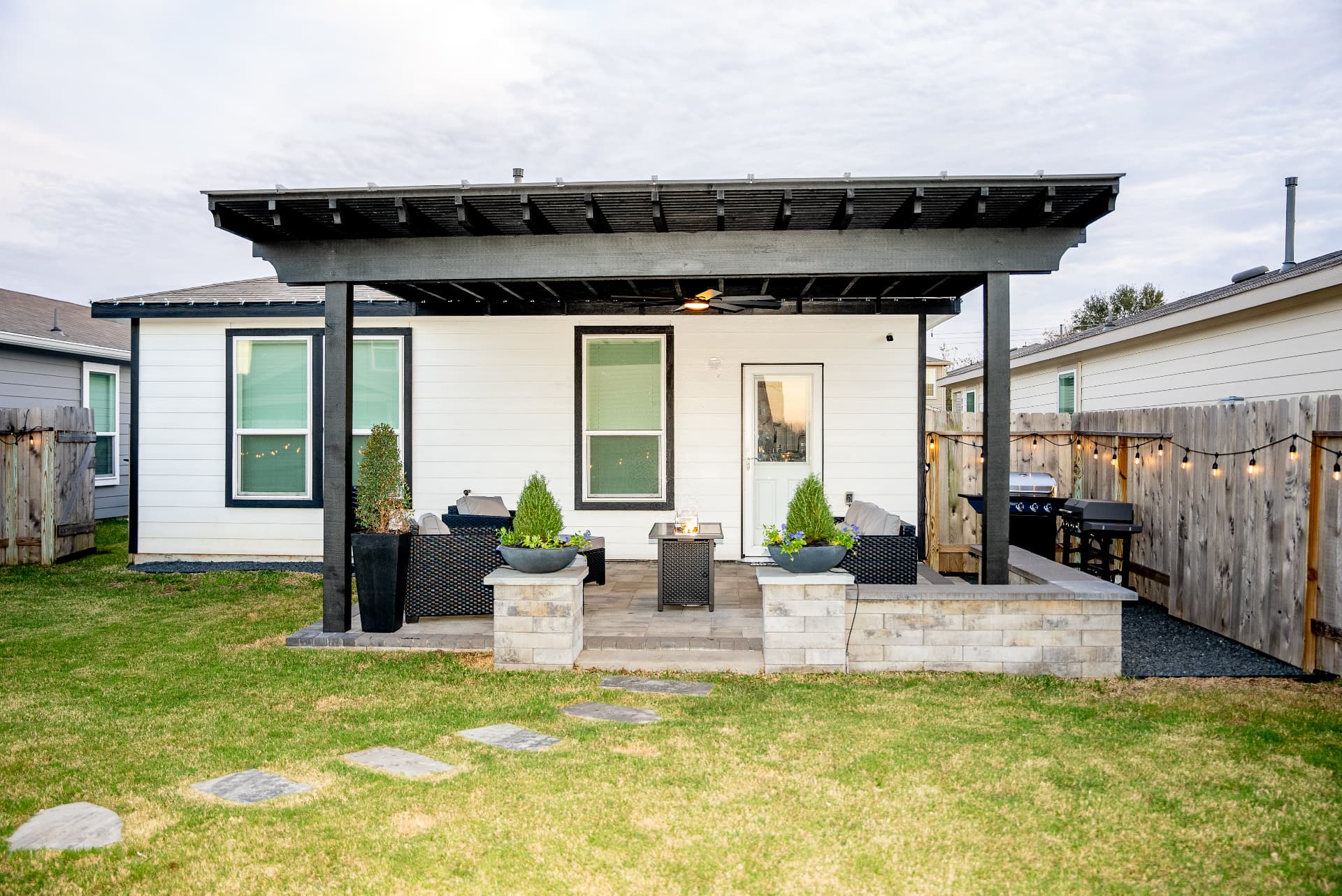
In The Woodlands, where outdoor living is a year-round priority, a quality paver patio is the foundation everything else is built around. Master-planned community properties with professional paver work consistently command higher resale prices and attract more buyer interest than those without.

01

The Pines Come First

A loblolly pine holds the bulk of its feeder roots within the first twelve to eighteen inches of soil, running outward far beyond the drip line rather than diving deep. Standard hardscape practice — strip eight inches across the whole footprint, compact heavy lifts of base rock over it — is a slow death sentence for a tree whose roots you just severed and whose remaining root zone you just sealed. We have seen the outcome on plenty of Woodlands lots: a beautiful patio, and three summers later a dead sixty-foot pine that costs thousands to remove over it.

The first drawing we produce, then, is a root survey — the layout comes after. We probe by hand near the trunks, map where structural roots actually run, and shape the patio around them — sometimes pulling an edge in three feet, sometimes wrapping the trunk with a generous open well. Where a client will not give up the footprint, we switch to reduced excavation over that zone: thinner open-graded base, geogrid to spread load, pavers set slightly proud of grade so we are adding material rather than stripping soil and air off the root plate.

Open-graded base is our default under any canopy here. Angular clean stone with no fines lets water and air pass straight through to the roots below instead of perching on a sealed layer. It costs somewhat more than conventional crushed limestone, and it is the difference between a patio a tree tolerates and one it resents.

02

What Falls From Above, and What It Does to Light Pavers

Pine straw, catkins, and spring pollen land on your patio continuously. As that material breaks down in damp shade it releases tannins that leach into porous stone and set as brown-yellow blotches. On warm-cream travertine or a pale limestone-look paver, six weeks of undisturbed needle cover in a corner nobody walks leaves a permanent shadow of itself. Homeowners blame the material. The material is fine; the problem is contact time.

That changes what we specify. On heavily wooded lots we steer toward mid-tone pavers with visible color variation — weathered browns, warm greys with charcoal flecking, tumbled units with range rather than one flat tone. Debris still lands, but the surface hides the staining cycle between cleanings instead of documenting it. Clients who want pale travertine get it, with the honest caveat that it is a higher-attention surface.

Sealing is the other lever, and here it earns its keep. A penetrating impregnating sealer fills the pore structure so tannin-laden water beads long enough for you to sweep it off. We favor matte penetrating products over wet-look films — gloss in dense shade gets slick, and the film flakes where it is walked. Plan on refreshing around the three-year mark, sooner on a north-facing patio.

03

Shade, Damp Joints, and the Algae Problem

A patio in full Houston sun bakes dry within an hour of a storm. A patio under a closed pine canopy on the north side of a house in Grogan's Mill can stay damp for two days. That persistent moisture, plus the fine organic dust that constantly settles from the trees, is exactly what algae and moss need. The slick green film that shows up on the shaded third of a Woodlands patio is not a defect in the pavers — it is biology finding a food source and a wet surface.

Joint stabilization is where we answer it. Polymeric sand hardens the joints so airborne organic dust and seeds have nowhere to root, and holds pavers tight enough that the surface sheds water instead of wicking it. In the deepest shade we specify higher-grade products rated for damp installation, since budget sands haze and fail when they cure in humidity. On genuinely wet patios we use a two-part epoxy-modified compound, which costs more and simply does not host growth.

Drainage design does the rest. Under canopy we hold a consistent slope — never below an eighth of an inch per foot — and we never let a patio dead-end against a bed or fence line where water can pond at the edge restraint. Where grade truly cannot fall away, a discreet channel drain at the low edge ties into daylight or existing yard lines. And the least glamorous instruction is the most effective one: keep the needles moving with a blower every week or two through the heavy shed seasons.

04

Working Within Village Design Review

The Woodlands carries a real architectural review culture, rooted in a development philosophy that built the community into the forest instead of clearing it. Reviewers here lean toward materials that recede into a wooded setting — earth tones, natural stone character, muted greys and browns — over high-contrast or brightly variegated product. That preference happens to match what we would specify for staining reasons anyway, which makes most patio approvals uneventful.

What draws questions is rarely the paving itself. It is the vertical and the visible: seat wall heights, columns, pergolas over the patio, fireplaces and chimneys, anything altering the lot's profile as seen from a neighbor or a pathway. Tree removal is its own conversation, and one we usually design our way out of needing.

Submission requirements and review timelines are set by the covenant administration for your village and section, and they change. Rather than repeat a rule that may be stale, we confirm what currently applies to your design while the proposal is being written, assemble the drawings and samples the reviewer expects, and file for you — with review time already inside the build schedule.

05

Budget: What Woodlands Homeowners Actually Spend

Installed concrete paver work in the Greater Houston market generally falls in the neighborhood of $14 to $25 per square foot, and a patio in the common 300 to 500 square foot range typically lands somewhere between $6,000 and $14,000 all in. Travertine and premium natural stone move the per-foot figure to roughly $22 to $38. Multi-zone hardscape packages — a dining terrace plus a fire feature plus connecting walkways — go beyond those brackets by design.

Woodlands projects tend to sit in the upper half of those bands for specific reasons. Hand excavation near root plates is slower than machine work. Open-graded base costs more than crushed limestone. A narrow wooded side yard often means wheelbarrowing material a skid steer would otherwise carry. And the jointing compounds deep shade demands cost more per bag.

Those items appear as separate lines on our proposals rather than disappearing into a single square-foot number, because line items let you trade. Some clients see the access surcharge and pull a fence panel for the week. Some see the travertine premium and decide a mid-tone paver was the smarter call under trees anyway.

06

Questions Worth Asking Any Contractor Here

Ask how they intend to protect the trees. A specific answer names hand-excavation zones, open-graded base, geogrid, and a willingness to move the patio edge. A vague one — we will be careful — means a machine to full depth and hope. Have them walk the yard and point at the roots they expect before they hand you a number.

Ask about base depth and compaction by name. We build in controlled lifts with a compactor sized to the material, over a geotextile separation fabric that stops clay subgrade from pumping up into the stone. A bid that never mentions fabric, lift thickness, or edge restraint is a bid on the pretty part only. And ask what happens if it settles — pavers are a flexible system, small areas lift and re-screed, and any serious installer will put a written workmanship period behind that.

07

Building It in Phases

A lot of Woodlands backyards are long and narrow with the interesting space at the back of the lot, and the full vision — terrace, path, fire area, lighting — is more than one season's budget. We plan for that openly. The first phase gets the base, drainage, and sleeving right across the whole future footprint even where the surface is not going in yet, so phase two is laying pavers rather than tearing up what phase one just built.

Sleeving is cheap now and painful later. Conduit for future low-voltage lighting, a gas sleeve toward wherever a fire feature might land, and a drainage stub at the low corner cost almost nothing while the trench is already open. Under a canopy that has a Woodlands backyard dark by seven, lighting is nearly always the phase-two ask.

What you get

What The Woodlands homeowners get

Wide selection of travertine, concrete, brick & natural stone

Engineered for Houston's expansive clay soil

Slip-resistant surfaces for pool and wet areas

Custom patterns, borders and inlays

Integrated drainage to prevent water pooling

Low maintenance and extremely durable

How it works

Your The Woodlands project, step by step

01

Property assessment and drainage evaluation

02

Design, material selection & layout plan

03

Excavation and base preparation

04

Paver installation, sealing and cleanup

Paver Patios across The Woodlands

Our crews work throughout The Woodlands — including these neighborhoods and the surrounding area.

Grogan's MillPanther CreekCochran's CrossingIndian SpringsAlden BridgeSterling RidgeCollege ParkCreekside ParkCarlton WoodsHarper's Landing

Questions

Paver Patios questions from The Woodlands homeowners

Paver Patios near The Woodlands

More services in The Woodlands

Popular pairings with paver patios: Pergolas, Outdoor Kitchens, Water Features.

Request a quote

Ready for paver patios at your The Woodlands home?

Greystone Landscapes has designed and built outdoor spaces across Greater Houston since 2005. Get a free on-site consultation for your The Woodlands project.

(281) 235-9143