
Greystone

After-Dark Curb Appeal · The Woodlands, TX

Landscape Lighting in The Woodlands, TX

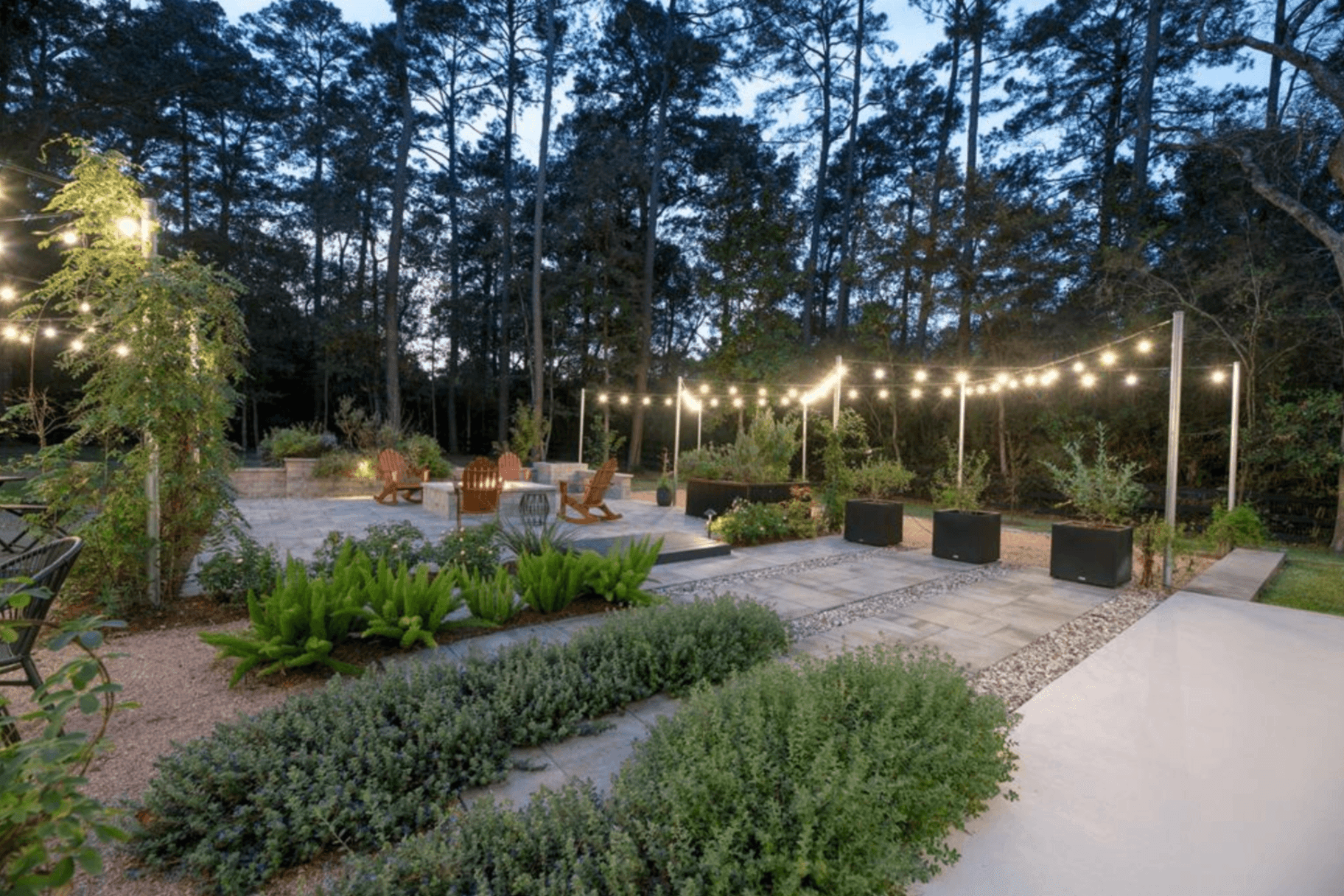
No other Houston submarket hands a lighting designer sixty-foot loblolly pines with clean trunks and a canopy that starts thirty feet off the ground. In Sterling Ridge, Alden Bridge, and Cochran's Crossing that structure makes genuine moonlighting — fixtures mounted high in the tree, aimed straight down, light filtering through needles and limbs onto the ground — the technique the property is built for, rather than a specialty add-on. The community's covenants and its long-standing preference for a dark, wooded evening character push in the same direction. Greystone Landscapes has been lighting Montgomery County properties since 2005. What follows is how we design to what The Woodlands already is instead of overriding it.

(281) 235-9143

Why here

Why landscape lighting make sense in The Woodlands

Landscape lighting in The Woodlands does more than look beautiful — it signals a well-maintained, premium property that stands out on the street. Master-planned community homeowners who invest in professional lighting consistently see the impact in curb appeal, security, and the number of evening hours they actually use their outdoor spaces.

01

Moonlighting from Sixty Feet Up

A loblolly gives you something a live oak does not: real height with a bare trunk beneath it. Set a shielded fixture thirty or forty feet up in that canopy, aim it down, and the needles and branch structure break the beam into a pattern of light and shadow across the lawn and beds below. It is the closest thing in landscape lighting to actual moonlight, and on a wooded Woodlands lot it lights a wide area from a source nobody standing in the yard can see.

That invisibility is the whole point of the technique. Because the fixture is far above eye level and shielded, there is no glare anywhere in the field of view — you register the illuminated ground and the shadow pattern, not a light. It also solves a problem specific to these lots: with pines this tall, ground-level uplighting mostly disappears into the trunk and never reaches the canopy at all, so a homeowner ends up adding fixtures and still finding the yard dark.

Mounting is the demanding part. Fixtures go up on stainless hardware sized for the limb, wire is run with slack loops so wind sway and annual growth do not stress the connection, and we choose a mount high enough to clear the lower branches that would otherwise block the beam. We plan for the climb again at service time — a fixture that can only be reached with a lift is a fixture that will not get maintained.

02

Warm, Low, and Restrained: the Local Aesthetic

The Woodlands has an unusually strong cultural preference for dark evenings. Streetlighting is deliberately sparse across much of the community, tree cover is protected, and residents are accustomed to a night landscape that reads as woods rather than as a lit subdivision. A system designed for a bright, open suburb looks wrong here in a way that shows up immediately in neighbor conversations and in review comments.

We design to that. Lower output lamps than we would use on an open lot, tighter beams aimed at particular targets instead of broad washes, generous unlit space between lit moments, and full shielding on anything that could throw light toward a neighboring lot, a greenbelt, or one of the pathways. The goal is a property where you can see the ground you are walking on and the shape of the house, and still see the sky through the pines.

Color temperature is where restraint matters most. We hold to 2700K almost everywhere in The Woodlands — warm enough to keep pine bark, brick, and stained cedar looking natural. Anything at 4000K or above turns pine needles a strange blue-green and makes a wooded lot look like a parking area, which is why we will not specify it here even when a homeowner arrives asking for brighter, whiter light.

03

Covenants, Design Review, and the Trees Themselves

The Woodlands runs one of the most established residential covenant systems in the region, and exterior improvements generally go through a formal application and approval process before work begins. Lighting is squarely within that scope. Rather than describe rules that get revised, our approach is to confirm what the current application requires for your village and lot while the design is still a drawing, and to submit the package ourselves under our name.

What we assemble typically includes a fixture plan drawn over your survey, mounting heights and aiming directions, cut sheets from the manufacturer documenting shielding and lumen output, plus the finish and color temperature we intend to install. Reviewers here consistently focus on the same things: whether light spills onto adjacent lots or common area, whether fixtures are visible from a pathway or the street, and whether the intensity fits the surrounding neighborhood.

Tree protection deserves separate attention. Covenants across The Woodlands restrict the removal and, in places, the alteration of significant trees, and the pines that make moonlighting possible are exactly the trees those provisions exist to protect. Our installations do not require cutting, topping, or heavy limbing — we work with a climber, mount to existing structure, and hand-dig or probe cable inside root zones instead of trenching through them.

04

Pine Straw, Pollen, and Real Maintenance Expectations

A pine canopy is a debris machine, and that shapes both what we install and how a system ages. Needles fall constantly and drift into fixture housings and lens recesses; the February and March pollen season coats every surface with yellow film; and small limbs come down in the storms that roll through each spring. A well-designed system anticipates this instead of pretending the yard is a clean site.

Practically, that means fixtures with smooth lens surfaces that shed debris rather than deep recessed wells that collect it, ground fixtures set slightly proud of the mulch line so accumulating needle litter does not bury them, and canopy-mounted units angled so straw slides off the housing. We also leave adjustment tolerance in the aim, because a beam calibrated in November through thinner branch cover will be reading differently by June.

Ongoing care is simple but not optional here: wipe lenses after pollen season, clear needle buildup around in-ground housings a couple of times a year, and re-aim canopy fixtures after major storms or heavy limb loss. We walk the system annually on request and handle it, and we tell homeowners plainly that a lighting system in a pine forest asks for more attention than one in an open St. Augustine lawn.

05

What a Woodlands System Costs

Pricing here is best understood per finished fixture, with everything that makes it work included in that number — the housing and lamp, its share of the transformer, the buried cable and connectors, the labor to install and aim it, and the warranty behind it. That all-in figure generally sits between $250 and $450 in the Houston market. Canopy mounts land toward the upper end, since a fixture forty feet up in a loblolly represents climbing time no ground-level installation requires.

For a typical Woodlands home, a twelve-to-twenty-fixture design covering the front elevation, the entry, a walk, and two or three specimen pines usually totals somewhere between $4,000 and $9,000. Estates in Carlton Woods or Creekside Park that add rear-yard moonlighting, a pool surround, and a longer approach commonly reach $10,000 to $25,000, sometimes past it, driven mostly by the number of trees climbed and the length of the cable runs.

Two things are worth paying for on a wooded lot. The first is solid brass housings, which survive years of wet needle litter and irrigation in a way that painted aluminum does not. The second is transformer capacity you do not need yet — pines grow, canopies shift, and a homeowner here almost always wants to light one more tree in year three. Both decisions cost modestly up front and save a rebuild later.

What you get

What The Woodlands homeowners get

Low-voltage LED systems with decades of lifespan

Path and step lighting for safety

Uplighting to showcase trees and architecture

Accent lighting for gardens and water features

Smart controls and timer systems

Professional installation with underground wiring

How it works

Your The Woodlands project, step by step

01

Property walkthrough and lighting design

02

Fixture and color temperature selection

03

Underground conduit and wire installation

04

Fixture placement, aiming and controller programming

Landscape Lighting across The Woodlands

Our crews work throughout The Woodlands — including these neighborhoods and the surrounding area.

Sterling RidgeAlden BridgeCochran's CrossingPanther CreekGrogan's MillIndian SpringsCollege ParkCreekside ParkCarlton WoodsVillage of Research Forest

Questions

Landscape Lighting questions from The Woodlands homeowners

Landscape Lighting near The Woodlands

More services in The Woodlands

Popular pairings with landscape lighting: Pergolas, Paver Patios, Water Features.

Request a quote

Ready for landscape lighting at your The Woodlands home?

Greystone Landscapes has designed and built outdoor spaces across Greater Houston since 2005. Get a free on-site consultation for your The Woodlands project.

(281) 235-9143