
Greystone

Hardscape Foundations · Sugar Land, TX

Paver Patios in Sugar Land, TX

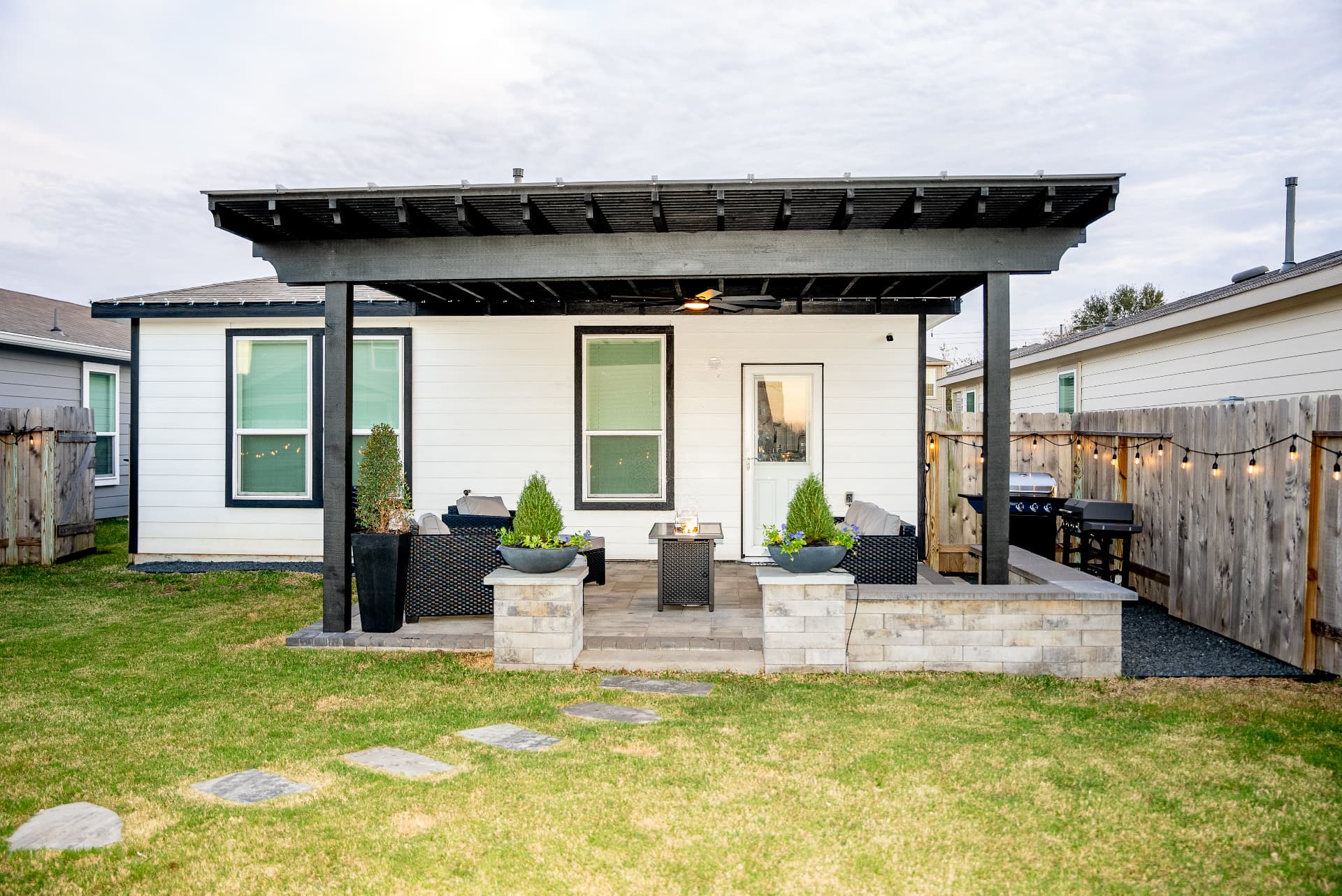
Sugar Land is not a suburb that behaves like a suburb. The city operates a permitting counter and an engineering review of its own, and the drainage districts here watch closely whatever gets added to a lot. Most of the neighborhoods we work in were built between the late 1970s and the early 2000s, which means the backyards already contain a pool, an irrigation system, twenty-year-old bed lines, and trees with real presence. A paver patio here is rarely a blank-slate installation. It is a remodel that has to respect what is already there and satisfy a city that reviews the work. Greystone Landscapes has built hardscape across Fort Bend County since 2005.

(281) 235-9143

Why here

Why paver patios make sense in Sugar Land

In Sugar Land, where outdoor living is a year-round priority, a quality paver patio is the foundation everything else is built around. Luxury suburb properties with professional paver work consistently command higher resale prices and attract more buyer interest than those without.

01

Why Does a Sugar Land Project Start Slower Than a Suburban One?

Because there is an actual review process. Unincorporated Fort Bend addresses answer mostly to a homeowners association; inside Sugar Land city limits you may be dealing with the city and the association, and the two run on separate calendars. We sequence them deliberately rather than in series when we can, so the association is looking at the design while the city is looking at the construction detail.

What triggers a permit depends on scope. A patio laid flat on the ground is treated differently than one with retaining walls, steps, structures, gas, or electrical, and drainage modifications get looked at closely in a city with Sugar Land's flood history. We check current requirements with the city for the exact scope you are buying, put any fees on the contract in plain sight, and file on your behalf.

The association side is its own conversation. First Colony's sub-associations, Sweetwater, Riverstone, and Telfair each have their own standards and their own meeting rhythm, and several pay attention to material color as well as the share of the lot that ends up under hard surface. We prepare the drawings and specifications and confirm each committee's current submission rules before we commit to a start date.

02

Where Does the Water Go in the Next Big Rain?

This is the first question we ask on a Sugar Land site visit, and homeowners here almost never find it strange. Flooding is recent memory in Fort Bend County, and the practical effect is that grading decisions carry more weight than paver selection. Before design, we shoot elevations across the yard, locate every downspout and area drain, and identify exactly where the lot currently discharges — street, rear swale, or a drainage easement between properties.

Then we design so the new surface improves the situation rather than adding to it. That usually means a consistent fall away from the house, hard surfaces pitched toward a collection point instead of toward the fence, downspouts captured into solid pipe rather than allowed to sheet across the new patio, and a channel drain where a large field would otherwise dump at one edge. On lots that sit low, we sometimes hold the patio slightly high and transition with a planted swale.

Permeable construction earns its keep on some of these lots. Pavers set on open-graded stone over a reservoir let a storm soak in and release slowly, which matters on a property with limited discharge or a neighbor sitting lower. Our clay does not infiltrate quickly, so we generally pair the reservoir with an underdrain. It costs more than a conventional build; on the right lot it is the cheapest real answer available.

03

How Do You Add a Patio to a Yard That Is Already Full?

Carefully, and with a shovel before a machine. A typical Sugar Land backyard has irrigation laterals running where you want to excavate, low-voltage lighting wire nobody documented, a pool return line, and bed lines that have been in place long enough that the plant material is worth protecting. We locate and flag before we dig, and we plan for the reality that some irrigation will need to be rerouted and re-headed after the patio is in.

Existing pools set the geometry. If the deck is staying, the new paver field has to arrive at the elevation the coping already establishes, which means the base is built to a fixed datum rather than to whatever grade suggests. If the deck is being replaced, we reset coping in matching stone, hold a positive pitch away from the water, and finish the joint flush so there is nothing to catch a bare foot.

Mature landscape is the other constraint, and it is a welcome one. Twenty-year-old live oaks and crape myrtles give these yards something newer neighborhoods will not have for decades. Critical root zones stay off limits to the excavator, margins get dug by hand, and design bed transitions with a steel or paver edge so the new hardscape reads as though it was always part of the plan rather than dropped on top of it.

One more remodel-era habit worth adopting: decide the whole plan now even if you build it in stages. Most of these projects eventually grow a shade structure, a kitchen, or lighting, and sleeving conduit and gas beneath an open base costs a fraction of what it costs to saw a finished patio apart two years later. We draw the full backyard, then price the phases separately so you can build in whatever order the budget allows.

04

Is Travertine Worth the Premium in These Neighborhoods?

In Sugar Land it is the material people ask for by name, and the reason is temperature. Underfoot in August, travertine reads markedly cooler than dense concrete does, which matters on a pool surround where people walk barefoot. The tumbled French pattern also suits the stone and stucco elevations common in Riverstone, Telfair, and the newer sections of Greatwood, and it satisfies design committees that scrutinize material choices.

The honest counterpoint is cost and care. Travertine carries a higher installed price than concrete pavers, it wants a penetrating sealer to resist staining, and around a saltwater pool the splash-out zone deserves attention. Concrete pavers have narrowed the aesthetic gap considerably and remain the better value for a large field that is not primarily a pool deck. We show both on site, in sun, wet and dry, before anyone commits.

Whatever the surface, the maintenance program in this climate is short: renew a breathable penetrating sealer periodically rather than once, top up stabilized joint sand every few seasons, and wash at low pressure. Skip the heavy gloss coatings sold as a shortcut; in our humidity they can trap moisture and cloud, and stripping one off is more work than the original install.

05

What Should a Sugar Land Patio Cost, and What Should You Ask?

Concrete pavers on a properly constructed base carry an installed cost of roughly $14 to $25 per square foot across Fort Bend County. Size that to what these backyards typically hold, 300 to 500 square feet, and the arithmetic works out to about $6,000 to $14,000. Travertine and other premium stone sit higher, around $22 to $38 per square foot, and a full hardscape package with seat walls, steps, drainage work, and a fire element goes above those brackets.

In Sugar Land the variables that move a number most are demolition of existing concrete, corrective drainage tied to a legitimate discharge point, pool deck and coping coordination, irrigation rework, and permit and review time. We break these out individually so you can weigh them, and we would rather explain a higher number than win the job by leaving the drainage off the estimate.

When you compare proposals, compare the parts you will never see. Ask for compacted base depth in inches and whether it is placed in lifts, whether geotextile separates the clay from the aggregate, how the perimeter is restrained, what stabilizes the joints, and what happens if a section settles in year three. A contractor who answers those four questions clearly is quoting a patio. One who changes the subject to pattern options is quoting a surface.

What you get

What Sugar Land homeowners get

Wide selection of travertine, concrete, brick & natural stone

Engineered for Houston's expansive clay soil

Slip-resistant surfaces for pool and wet areas

Custom patterns, borders and inlays

Integrated drainage to prevent water pooling

Low maintenance and extremely durable

How it works

Your Sugar Land project, step by step

01

Property assessment and drainage evaluation

02

Design, material selection & layout plan

03

Excavation and base preparation

04

Paver installation, sealing and cleanup

Paver Patios across Sugar Land

Our crews work throughout Sugar Land — including these neighborhoods and the surrounding area.

Sugar CreekFirst ColonySweetwaterNew TerritoryTelfairRiverstoneGreatwoodImperialColony BendAvalon

Questions

Paver Patios questions from Sugar Land homeowners

Paver Patios near Sugar Land

More services in Sugar Land

Popular pairings with paver patios: Pergolas, Outdoor Kitchens, Water Features.

Request a quote

Ready for paver patios at your Sugar Land home?

Greystone Landscapes has designed and built outdoor spaces across Greater Houston since 2005. Get a free on-site consultation for your Sugar Land project.

(281) 235-9143