
Greystone

After-Dark Curb Appeal · Sugar Land, TX

Landscape Lighting in Sugar Land, TX

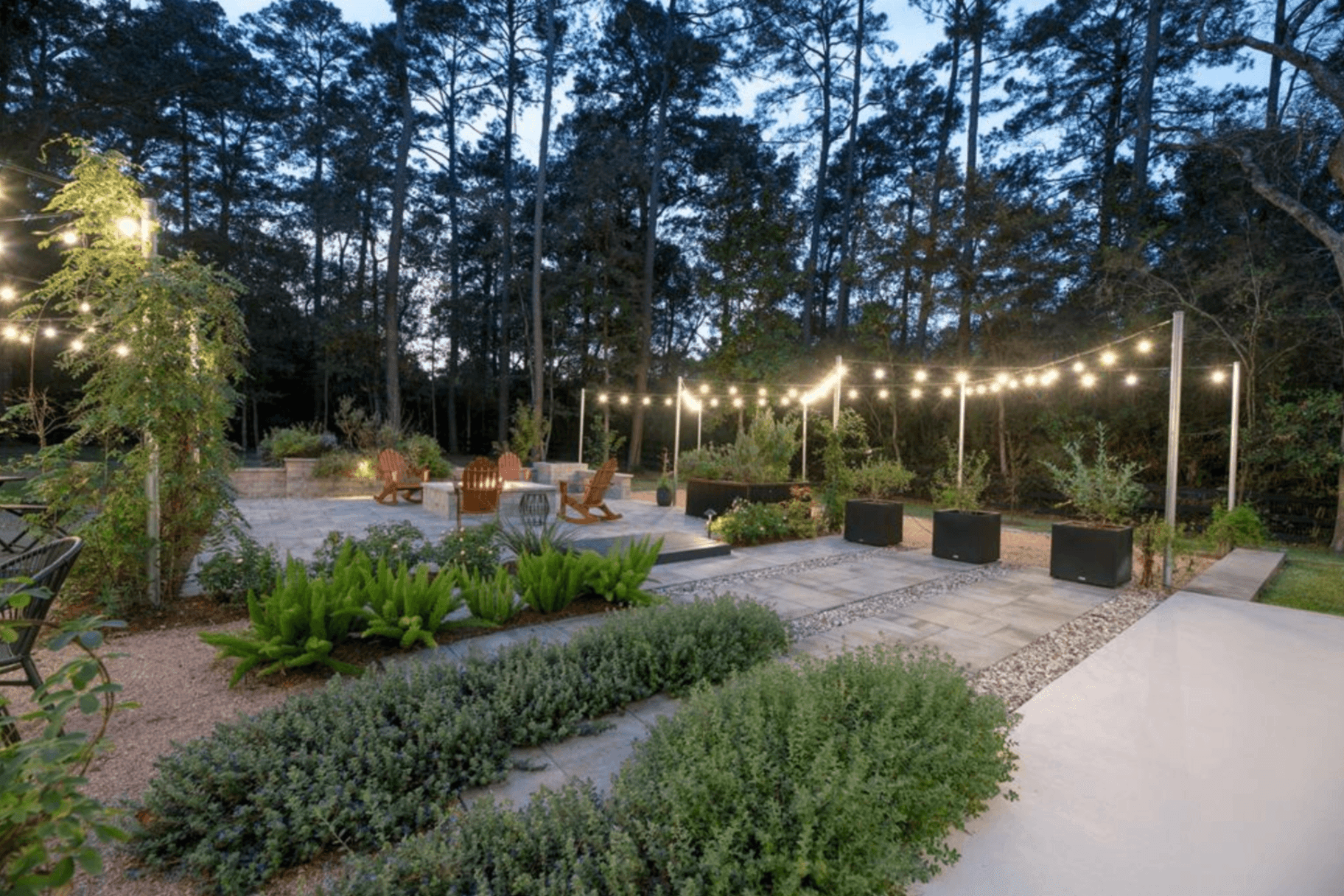
Sugar Land's older sections were platted back when developers still left trees standing, and four decades later that decision is the single greatest asset a lighting designer has here. First Colony, Sugar Creek, and Greatwood are full of live oaks and southern magnolias with canopies wide enough to hang fixtures twenty-five or thirty feet up and let light drift down through the branches the way a full moon does. Pair that with the brick-and-cast-stone facades that dominate the housing stock and you get a market where the best work is subtractive — fewer fixtures, aimed with more patience. Greystone Landscapes has been installing low-voltage systems across Fort Bend County since 2005, and this page covers how we design, wire, permit, and price lighting on established Sugar Land lots.

(281) 235-9143

Why here

Why landscape lighting make sense in Sugar Land

Landscape lighting in Sugar Land does more than look beautiful — it signals a well-maintained, premium property that stands out on the street. Luxury suburb homeowners who invest in professional lighting consistently see the impact in curb appeal, security, and the number of evening hours they actually use their outdoor spaces.

01

Moonlighting: Putting the Fixture in the Tree, Not Under It

The default suburban approach is to ring a tree with uplights and call it done. On a fifty-year-old live oak in First Colony that yields a glowing trunk and a black lawn, because the light is going up into leaves that absorb it. What earns its keep on these lots is downlighting from inside the canopy: shielded fixtures set high on a scaffold branch and aimed down, so the limb structure works as a stencil and the ground picks up a dappled pattern. Homeowners tend to describe the result as looking like nothing was installed, which is the compliment we want.

Getting there is climbing work, not landscape work. We set fixtures on stainless hardware that does not girdle the limb, run the leader wire along the branch with slack loops so growth and sway cannot pull the connection apart, and return to adjust aim after a full season. On a mature magnolia, where foliage is dense and low, we pair one high downlight with a tight-beam fixture at the base so the trunk does not disappear.

Beam angle discipline matters more than fixture count. A twenty-degree optic thirty feet up covers a wide circle by the time it reaches the St. Augustine, so two or three well-placed downlights will often cover a side yard that a contractor working from the ground would have filled with eight or ten path lights.

02

Grazing Brick, Cast Stone, and the Mixed Facades Here

Sugar Land's dominant architecture is brick with cast stone accents, and both reward light arriving at a steep angle. Set a fixture eight to twelve inches off the wall, aimed nearly straight up, and every mortar joint throws its own small shadow. Pull it back three feet and the wall goes flat. That distance is the difference between a system that makes a house look substantial and one that just makes it bright.

Not every wall should be grazed, though. Smooth painted stucco, the wide flat elevations you find on some of the newer Riverstone and Telfair product, and any surface with visible patch repairs all look worse under raking light because the technique advertises texture that is either absent or inconsistent. On those homes we shift to wall washing from farther out, or we skip the field of the wall entirely and light the architectural moments instead: the column entry, the arched window head, the gable that gives the elevation its shape.

Color temperature holds the facade together. We specify 2700K on red and blend brick to keep the clay warm and step to 3000K on limestone-toned cast stone so it reads clean instead of yellow.

03

Running Wire Through Beds That Have Been There Thirty Years

Retrofitting an established Sugar Land property is a root problem before it is a wiring problem. Under the mulch in these decades-old beds are oak feeder roots, boxwood hedges nobody wants replaced, and irrigation laterals installed on a plan no one has a copy of. A crew with a trenching machine gets cable in fast and costs the homeowner a shrub row six months later.

Our method is slower on purpose. We hand-trench with a spade at four to six inches through planted beds, follow bed edges and hardscape seams rather than cutting across a root plate, and switch to a soil probe where cable passes inside a mature tree's critical root zone. Where a run must cross a driveway we bore under it rather than saw-cut, and we sleeve the crossing so the conductor can be replaced in fifteen years without touching the concrete.

The irrigation system gets its own walk-through before anyone digs. We locate heads and confirm lateral routing where an as-built exists; where it does not, we probe carefully and accept that we will occasionally find a line the hard way. When that happens we repair it the same day with a proper coupling, and we tell you it happened.

04

The 120-Volt Side and Sugar Land's Electrical Review

Everything downstream of the transformer is low voltage and carries no shock risk worth worrying about. Everything upstream is ordinary house wiring, and that is where the city has an interest. Sugar Land is incorporated, with a permitting and inspections department answering to the city rather than to the county, and while the buried twelve-volt cable itself is generally not the concern, adding a dedicated exterior circuit, installing a new GFCI-protected outdoor receptacle, or bringing a panel breaker into the job typically falls under electrical permitting and licensed-electrician requirements.

We settle the electrical scope before the proposal is priced rather than after. If your exterior receptacle is GFCI-protected, weather-rated, and has capacity for the transformer we specified, the system plugs in and no permit question arises. If it does not, we confirm with the city what that specific work requires now, price the licensed electrical portion as a visible line item, and schedule the inspection into the timeline.

Transformer placement is a small decision with long consequences. We wall-mount stainless units in a side yard near the receptacle, off grade and out of the splash zone, with the terminal block reachable without moving a plant.

05

What Sugar Land Architectural Committees Tend to Care About

The HOAs across Sugar Land's established communities are long-standing and organized, and their design committees have seen enough bad lighting to have opinions. The recurring concerns are glare crossing property lines, fixtures visible from the street in daylight, and brightness that makes one house conspicuous against its neighbors. Path lights marching down a front walk draw more comment than almost anything else, which is another reason we lean on downlighting.

Because requirements differ from one community and section to the next, we treat the review as part of the job rather than the homeowner's homework. We assemble what the committee needs — a fixture layout over your plat, cut sheets showing shielding and lumen output, mounting heights, finishes, and color temperature — and submit it under our name. Committees turn over and rules change, so we confirm what your association wants at the time we quote.

06

Budgeting a System on an Established Sugar Land Lot

Think in fixtures, not in square footage. Installed and warrantied, with the transformer, direct-burial cable, connectors, and labor all folded in, a professional low-voltage fixture generally lands somewhere between $250 and $450 — the spread reflects brass versus composite housings, whether the fixture goes in the ground or thirty feet up a tree, and how far it sits from the transformer. A typical whole-home layout of twelve to twenty fixtures therefore falls in the $4,000 to $9,000 band, and that is where most Sugar Land front-and-entry projects land.

Larger properties scale past that quickly. Lighting a deep rear lot, a pool surround, and a stand of oaks on a Sugar Creek or Avalon estate parcel puts systems in the $10,000 to $25,000 and up range — multiple transformers, longer home runs in heavier cable, and the tree work canopy mounting requires. What moves a Sugar Land number most is rarely the fixture; it is climbing time, boring under hardscape, and hand-digging through beds nobody wants disturbed.

Brass costs more up front and is the cheaper choice on a fifteen-year horizon in Fort Bend County, where irrigation water, fertilizer salts, and humidity work on hardware year-round. We quote brass as the default in beds and near sprinkler heads.

07

Reading a Lighting Bid Line by Line

If you are collecting quotes, three things reveal more than the bottom number. First, does the bid name the fixture manufacturer, housing material, optic angle, and Kelvin temperature, or does it just say sixteen lights? Second, what gauge is the cable and how are the connections made — direct-burial silicone-filled connectors that survive being underwater in a Gulf Coast bed, or twist caps wrapped in tape? Third, is the transformer sized with real headroom above the connected load, or exactly at it, which guarantees you cannot add a fixture later without replacing the box.

Ask about the second visit, too. Aiming in daylight is guesswork; every layout we install gets a night walk where we adjust beam direction, swap an optic throwing glare at a bedroom window, and set the schedule with you standing there. A bid that treats the job as finished when the trench closes is quoting something lesser.

What you get

What Sugar Land homeowners get

Low-voltage LED systems with decades of lifespan

Path and step lighting for safety

Uplighting to showcase trees and architecture

Accent lighting for gardens and water features

Smart controls and timer systems

Professional installation with underground wiring

How it works

Your Sugar Land project, step by step

01

Property walkthrough and lighting design

02

Fixture and color temperature selection

03

Underground conduit and wire installation

04

Fixture placement, aiming and controller programming

Landscape Lighting across Sugar Land

Our crews work throughout Sugar Land — including these neighborhoods and the surrounding area.

First ColonySugar CreekGreatwoodRiverstoneTelfairNew TerritoryCommonwealthAvalonSweetwaterImperial

Questions

Landscape Lighting questions from Sugar Land homeowners

Landscape Lighting near Sugar Land

More services in Sugar Land

Popular pairings with landscape lighting: Pergolas, Paver Patios, Water Features.

Request a quote

Ready for landscape lighting at your Sugar Land home?

Greystone Landscapes has designed and built outdoor spaces across Greater Houston since 2005. Get a free on-site consultation for your Sugar Land project.

(281) 235-9143