
Greystone

After-Dark Curb Appeal · Houston, TX

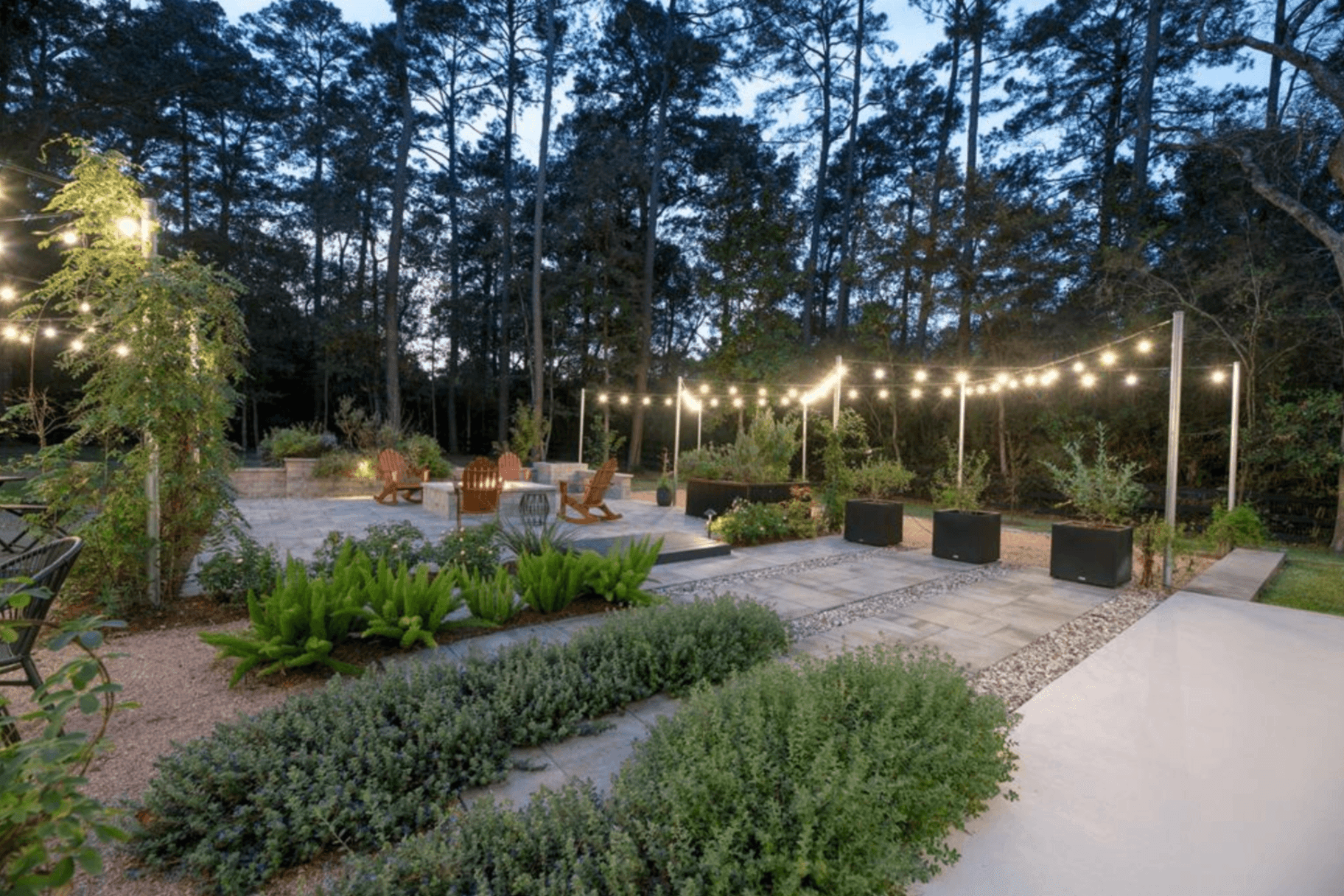
Landscape Lighting in Houston, TX

Inside the Loop, a lighting plan is really an architecture problem. The block you live on might hold a 1925 bungalow, a 1955 ranch, and a 2022 three-story rebuild within a hundred feet of each other, each one wanting a completely different treatment, all of them close enough that whatever we aim also lands in somebody's bedroom window. Add the live oaks that arch over streets in Norhill, Riverside Terrace, and Braeswood Place — the single best lighting asset a Houston property can have — and the job stops being about sticking fixtures in beds. Greystone Landscapes has designed and installed lighting across central Houston since 2005, and the sections below cover what changes when the lot is narrow and the neighbors are close.

(281) 235-9143

Why here

Why landscape lighting make sense in Houston

Landscape lighting in Houston does more than look beautiful — it signals a well-maintained, premium property that stands out on the street. Major metropolitan homeowners who invest in professional lighting consistently see the impact in curb appeal, security, and the number of evening hours they actually use their outdoor spaces.

01

A 1925 Bungalow and a 2022 Rebuild Need Opposite Light

Older Houston housing stock is built out of shadow and texture: deep porches, tapered columns, exposed rafter tails, brick or shingle siding with real relief. Those facades come alive under wide-beam grazing light placed close to the wall, where the shallow angle catches every edge. Center a narrow spot on the front door of a Heights bungalow and you flatten the very details that make it worth looking at.

The modern rebuilds going up across Rice Military, Montrose, and the Washington corridor are the reverse problem — smooth stucco, large glass planes, crisp parapets and almost no texture to reveal. There, light works as geometry. We use tight beam spreads to draw deliberate columns of light up flat surfaces, hide linear fixtures under overhangs to skim a soffit, and leave sections dark on purpose so the lit shapes read as composition rather than floodwash. Glass is the constraint: aim a fixture at a window wall and you have lit the inside of the living room for the whole street.

Color temperature carries a lot of this. Warmer light around 2700K flatters brick, limestone, wood, and the copper and bronze finishes common on older homes. Cooler light near 3000K holds white stucco and painted trim without pushing them yellow. On a mixed facade we will run two temperatures on the same house and nobody notices the difference except that it looks correct.

02

Moonlighting the Live Oaks

The technique that produces the biggest reaction on a Houston property costs relatively little: fixtures mounted high in a mature live oak, aimed down through the branches, throwing dappled shadow across the lawn and driveway the way a full moon does. It lights the ground softly and evenly, it makes a narrow lot feel considerably larger, and it looks like nothing was installed at all.

Doing it right is a tree-care job as much as a lighting job. Fixtures are mounted with expansion hardware that the tree grows around instead of being screwed down tight or, worse, wrapped with wire that girdles a limb within a few seasons. Cable is run loosely with slack left at every attachment so growth does not put the conductor in tension. We plan a return visit as the tree adds diameter, because hardware that was correct on install day needs adjusting later.

Below the canopy, a couple of uplights washing into the interior branch structure add depth so the trunk does not read as a black column under a lit crown. Where a live oak sits close to the house, we angle those uplights away from windows and shield them, since a fixture pointed into a canopy at the property line also points at whatever is behind it.

03

Security on a Fifty-Foot Lot, Without the Floodlight

Most inner-Houston security lighting we are asked to fix is a single glaring floodlight over the garage. It creates a bright pool and deep black shadows on either side, and human eyes adapting to that contrast see less than they would with no light at all. Layered low-level light does the opposite: uniform, low-glare illumination along the driveway, the side passage, the gate, and the back steps means there is nowhere on the property that reads as a hiding place.

Narrow lots make side yards the priority. The four-foot gap between a Houston house and its fence is the least-watched part of the property and usually the darkest. Small shielded path or hardscape fixtures spaced along that run, plus a light at the gate latch where people actually need to see, covers it without a single high-wattage source.

We wire the plan in zones on an astronomic timer so the architectural and tree lighting shuts off late in the evening while the perimeter and entry stay lit until dawn. Running the whole system all night wastes energy, shortens driver life, and irritates the people who live twenty feet away.

Motion sensing has a limited role here. On a street where cars, pedestrians, and cats pass within a few feet of the house all night, a motion-triggered floodlight fires constantly until the household stops noticing it entirely. We would rather deliver steady, modest light everywhere than a bright surprise nobody reacts to anymore.

04

Fifteen Feet to the Neighbor's Bedroom

Light trespass is the issue nobody raises during design and everybody raises afterward. On a typical central Houston lot, your side property line is a few strides from your wall and the neighbor's window is a few strides beyond it. A fixture aimed generously up a side elevation will absolutely put light where someone is trying to sleep.

Our defaults handle most of it: shielded and louvered fixture housings, glare guards on anything visible from a walkway, beam spreads chosen to end at the roofline instead of continuing into the sky, and fixture placement pulled back from the property line so the throw stays on your building. We aim at night, with the neighbor's side of the fence in mind, and we adjust rather than leave a hot spot for someone else to live with.

It is also the neighborly move to say what you are doing before the crew arrives. A short conversation across the fence has saved more Houston lighting projects than any piece of hardware, particularly in neighborhoods where civic clubs and deed restrictions give a bothered neighbor a real avenue.

05

Voltage, Permits, and the Price of Doing It Properly

Nearly everything we install is low voltage — a transformer steps 120 volts down to 12 or 15, which is safer around irrigation, roots, and kids, and lets us add or move fixtures later without an electrician. The line-voltage side of the work is the transformer's dedicated exterior circuit and any hardwired feeds, and that is regulated. Where a project needs new line-voltage circuits, we bring in a licensed electrician and ask the Houston Permitting Center directly which requirements attach to your specific installation while the proposal is still being drafted, with any fees written into the contract.

Old Houston homes bring a wrinkle: panels in 1940s and 1950s houses are frequently full, and finding a spare breaker for a lighting transformer sometimes turns into a panel conversation. We flag that on the first visit rather than discovering it on install day.

On budget, our pricing works out per fixture rather than per foot: figure roughly $250 to $450 for each installed fixture, with the transformer, buried wire, connections, and labor all inside that number. A typical inner-loop home lit properly takes 12 to 20 fixtures and lands between $4,000 and $9,000. Larger properties with multiple oaks, a deep back garden, and lit hardscape run from $10,000 into the $25,000-and-up range. Trenching under an existing driveway, mounting high in a big tree, and integrating with a smart-home controller are the three items that move a quote most.

What you get

What Houston homeowners get

Low-voltage LED systems with decades of lifespan

Path and step lighting for safety

Uplighting to showcase trees and architecture

Accent lighting for gardens and water features

Smart controls and timer systems

Professional installation with underground wiring

How it works

Your Houston project, step by step

01

Property walkthrough and lighting design

02

Fixture and color temperature selection

03

Underground conduit and wire installation

04

Fixture placement, aiming and controller programming

Landscape Lighting across Houston

Our crews work throughout Houston — including these neighborhoods and the surrounding area.

Houston HeightsNorhillMontroseRice MilitaryRiverside TerraceBraeswood PlaceEastwoodGarden OaksWoodland HeightsSouthgate

Questions

Landscape Lighting questions from Houston homeowners

Landscape Lighting near Houston

More services in Houston

Popular pairings with landscape lighting: Pergolas, Paver Patios, Water Features.

Request a quote

Ready for landscape lighting at your Houston home?

Greystone Landscapes has designed and built outdoor spaces across Greater Houston since 2005. Get a free on-site consultation for your Houston project.

(281) 235-9143