
Engineer for the Gust, Not the Average Day
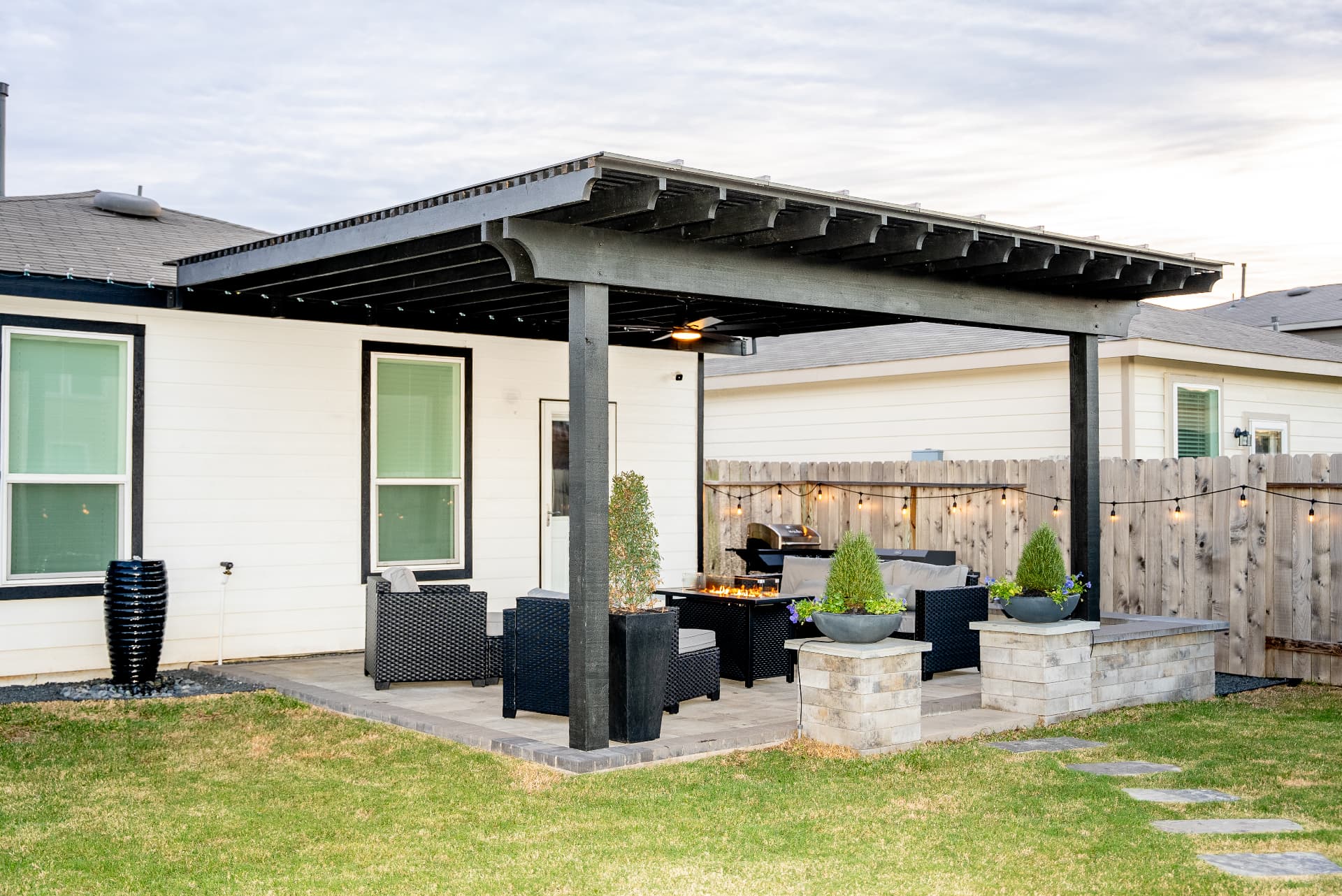
Wind load is where a coastal pergola earns or loses its keep. An open-roof pergola actually sheds wind better than a solid patio cover, but the frame still takes serious lateral and uplift forces when a squall crosses Clear Lake — and the failure point is never the middle of a beam, it's a connection. So our League City builds put the money where the wind goes: post bases anchored in properly sized concrete footings rather than surface-mounted to a thin slab, through-bolted beam-to-post connections instead of nailed or screwed hangers, and hardware rated for the loads this close to the bay.
Height and exposure shape the design too. Newer sections toward the east side of League City — Mar Bella, Coastal Point — sit on open, young-tree lots where the structure catches everything the sky sends; established streets around Countryside and older South Shore Harbour have maturing canopies and closer rooflines that buffer gusts. On exposed lots we favor stouter posts, tighter knee-brace geometry, and lower profiles over tall, willowy frames.
Louvered-roof systems deserve a specific coastal note: their ability to open fully is a wind strategy in itself. Louvers left open let a storm blow through; the same roof sealed shut for a summer downpour drains through integrated gutters. It's the rare product category where the coastal argument and the comfort argument point at the same purchase.
What we won't do in League City is value-engineer the invisible parts. A pergola that racks out of square after its second tropical storm season was mis-built on day one, and the difference was a few hundred dollars of embedment and hardware nobody could see at the final walkthrough.