
Greystone

Shade & Structure · Missouri City, TX

Pergolas in Missouri City, TX

Missouri City's backyards span fifty years of Houston suburban history, and a pergola project here starts by asking which era you own. Quail Valley's golf-course lots went in during the 1970s and 80s and now carry some of the best mature tree canopy in Fort Bend County — along with original arbors and patio covers reaching the end of their lives. Riverstone and the sections near Sienna are a different world: newer slabs, active design review, young trees, full sun. Lake Olympia, Colony Lakes, and Vicksburg sit somewhere between. Greystone Landscapes has worked across all of it since 2005, and the right pergola for a 1978 Quail Valley ranch is genuinely not the same structure, or the same project, as the right one behind a 2018 build. This page covers both, plus what everything costs.

(281) 235-9143

Why here

Why pergolas make sense in Missouri City

In Missouri City, a pergola isn't just a structure — it's the centerpiece of your outdoor living investment. Master-planned community homeowners consistently find that a well-designed pergola adds more usable square footage and tangible resale value than almost any other backyard upgrade.

01

One City, Two Generations of Backyard

The practical differences between Missouri City's older and newer sections show up in the first ten minutes of a site visit. On a Quail Valley or Hunters Glen lot, we're working around forty-year-old oaks and pines, an original patio slab that has moved with the clay for decades, and often an existing arbor bolted to the house in ways that wouldn't pass a modern inspection. On a Riverstone-area lot, the constraints flip: the slab is sound but small, the yard is open sun with no canopy relief, and the HOA's design guidelines have opinions about materials and colors.

Those starting points drive opposite designs. Established-section pergolas are usually about editing — replacing a failing structure with something better proportioned, working shade around trees that already provide some, and updating the look of a patio that's had three owners. New-section pergolas are about creating from zero: the structure is often the only shade the yard will have for fifteen years, so it has to carry the full comfort load on its own.

We think this range is what makes Missouri City work interesting. The same crew that hand-digs footings around a Quail Valley oak's root zone spends the next week erecting a louvered aluminum system on a bare Sienna-adjacent lot, and both clients get a structure designed for the yard they actually have.

02

Retiring the Original Arbor Gracefully

A large share of our Missouri City pergola calls start the same way: the arbor or patio cover that came with the house is sagging, rotting at the post bases, or lost its ledger flashing years ago and has been quietly wicking water into the band joist. Structures built in the 70s and 80s used the lumber and fastening practices of their day, and even well-maintained ones are simply old. The question is whether to repair or replace, and we answer it honestly — but when posts have rotted at grade and connections have worked loose through decades of clay movement, replacement is almost always the better spend.

Demolition on these projects deserves more respect than it usually gets. Original structures are often tied into the roof framing or embedded in a slab that stays, and careless removal damages both. We take the old structure down surgically, assess what the slab and house wall can support, and repair any concealed water damage at the ledger line before the new structure goes up — because covering rot with fresh cedar just schedules the next failure.

The upgrade payoff is substantial. Modern footing design handles Fort Bend clay movement far better than the shallow piers of 1978, hidden steel connection hardware outlasts the nailed joints it replaces, and a properly proportioned pergola can correct the slightly-too-low, slightly-too-dark feeling many original covers gave these patios.

03

Mature Canopy Is an Asset — Build Like It

The oaks and pines on Quail Valley's fairway lots took four decades to get where they are, and no pergola is worth wounding one. Where the build zone overlaps a canopy, we set footings clear of the critical root zone, dig by hand anywhere an auger would rip through structural roots, and shift the structure's geometry — shorter spans, relocated posts, occasionally a cantilevered corner — rather than cut what can't regrow.

Canopy also changes the shade math in your favor. A yard with high, mature shade doesn't need the dense rafter coverage a bare lot demands, so established-section designs can run lighter and more open — more sky, more architectural rhythm, less lumber. We map where the existing shade lands through a summer afternoon and let the pergola cover the gap, not duplicate what the trees already do.

The one caution mature trees add: droppage. Oak catkins, pine needles, and leaf load will find any horizontal surface, so under heavy canopy we're honest about the maintenance difference between an open-rafter cedar top that sheds debris through and a louvered roof that will need seasonal clearing. Both are fine answers; you should just pick one knowing the sweep-out schedule.

04

Matching Structure to Architecture, 1975 to 2025

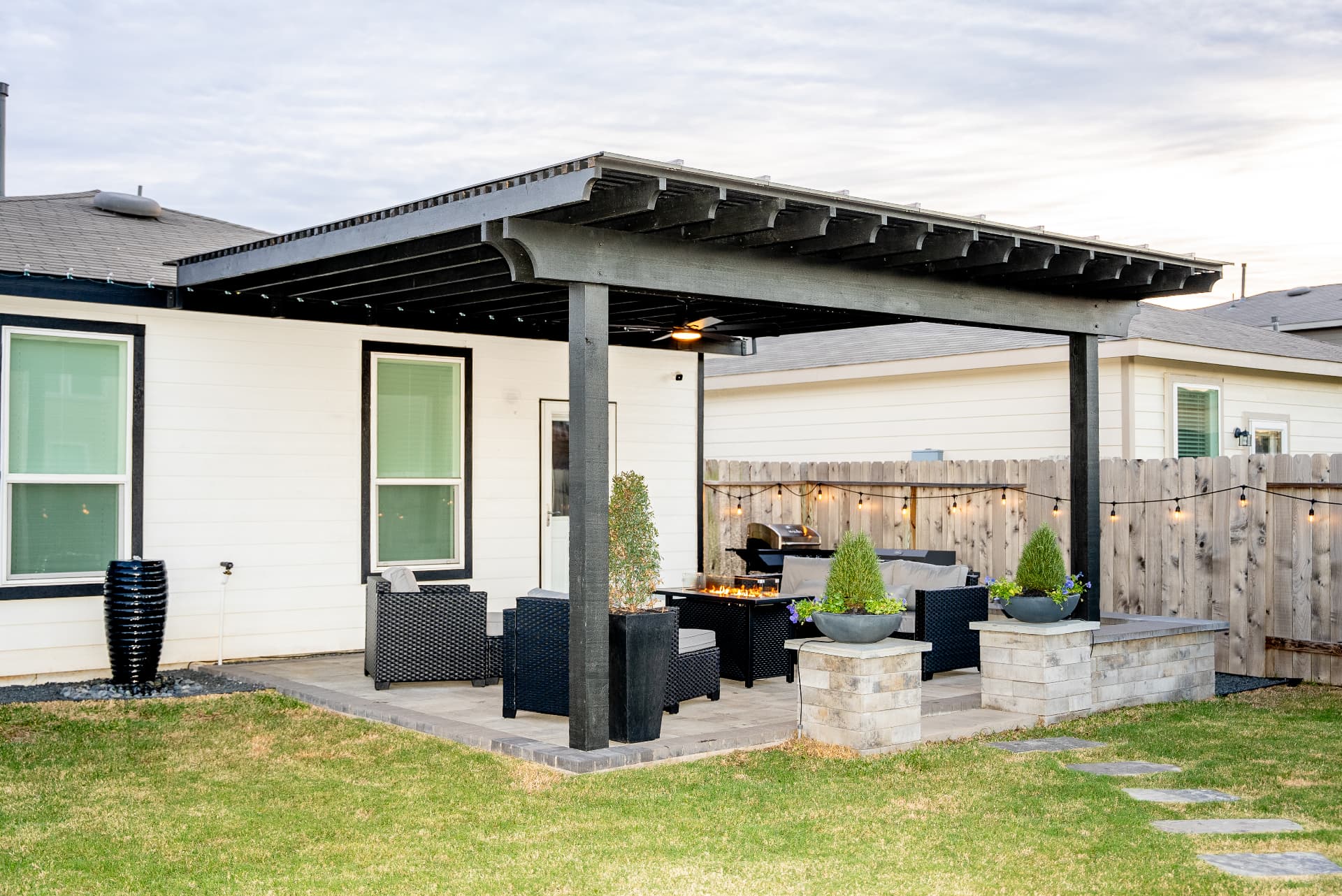
Missouri City's established sections are full of low-slung brick ranches and traditional two-stories with generous eaves, and a pergola reads best on these homes when it borrows their proportions — deeper beam profiles, rafter tails shaped to echo the eave line, stain tones pulled from the brick rather than fighting it. Cedar is usually the natural match here, and at $5,500 to $14,000 installed it covers everything from a modest 10x14 over a den slider to a full-width structure across the back of the house.

Newer homes near Sienna and in Riverstone lean toward crisper lines, and powder-coated aluminum suits them: slim profiles, longer spans without intermediate posts, and integrated louvered roofs that close against rain. Those systems begin near $14,000, and with motors, lighting, and screens on board they run to $22,000–$34,000. On open new-construction lots where the pergola is the only shade for years, the louver investment earns its keep fastest.

Either direction, the structure should look intentional rather than cataloged. We design from your elevation photos and actual patio dimensions, and the difference between a pergola that looks factory-ordered and one that looks original to the house is mostly in details that cost little: post trim, end-cut profiles, and getting the height right relative to the eaves.

05

Who Approves What in Missouri City

Approvals here vary by section age as much as anything. Newer communities like Riverstone run active architectural review with published guidelines, while Quail Valley and other established neighborhoods work through longer-standing associations whose processes are lighter but still real. Whichever applies to you, we prepare the complete submission — site plan, elevations, materials — and design within your community's standards from the first sketch so approval is a formality, not a negotiation.

The City of Missouri City has its own permitting layer for the scopes that typically accompany a pergola: electrical for fans and lighting, gas for heaters, and in some configurations the structure itself. What the city currently requires gets verified as we prepare your proposal; permit costs ride in the contract, and inspections are ours to handle. On replacement projects we also check whether the original structure ever had its situation regularized — occasionally the honest path is bringing a long-standing condition up to current standards as part of the rebuild.

06

Budgets, Timelines, and the Replacement Premium

The installed ranges hold across Missouri City: cedar pergolas from $5,500 to $14,000, louvered aluminum systems from $14,000 up to $22,000–$34,000 fully outfitted. Replacement projects carry a modest premium over bare-lot builds — demolition, haul-off, and any repair at the ledger or slab — and we itemize those lines separately so you can see exactly what the old structure's retirement costs versus what the new one does.

Timeline-wise, most cedar builds run two to five days on site and louvered systems three to six, with demolition adding a day or two up front on replacement jobs. One project lead carries the job from first visit through walkthrough, including the HOA packet and any city permitting, so a Quail Valley homeowner replacing a 1980s arbor and a Riverstone homeowner adding first shade both deal with exactly one person — and both end up with a structure built for the next forty years, not the last.

What you get

What Missouri City homeowners get

Custom cedar, redwood & aluminum designs

Creates shade without blocking breezes

Increases usable outdoor living space year-round

Adds architectural interest and property value

Customizable with lighting, fans, and climbing plants

Built to withstand Houston humidity and heat

How it works

Your Missouri City project, step by step

01

Initial consultation & property assessment

02

Custom design and material selection

03

HOA plan submission (if needed)

04

Professional installation with cleanup

Pergolas across Missouri City

Our crews work throughout Missouri City — including these neighborhoods and the surrounding area.

Quail ValleyRiverstoneSiennaLake OlympiaColony LakesVicksburgHunters GlenMeadowcreekQuail GreenParks Edge

Questions

Pergolas questions from Missouri City homeowners

Pergolas near Missouri City

More services in Missouri City

Popular pairings with pergolas: Outdoor Kitchens, Paver Patios, Landscape Lighting.

Request a quote

Ready for pergolas at your Missouri City home?

Greystone Landscapes has designed and built outdoor spaces across Greater Houston since 2005. Get a free on-site consultation for your Missouri City project.

(281) 235-9143