
Greystone

After-Dark Curb Appeal · Kingwood, TX

Landscape Lighting in Kingwood, TX

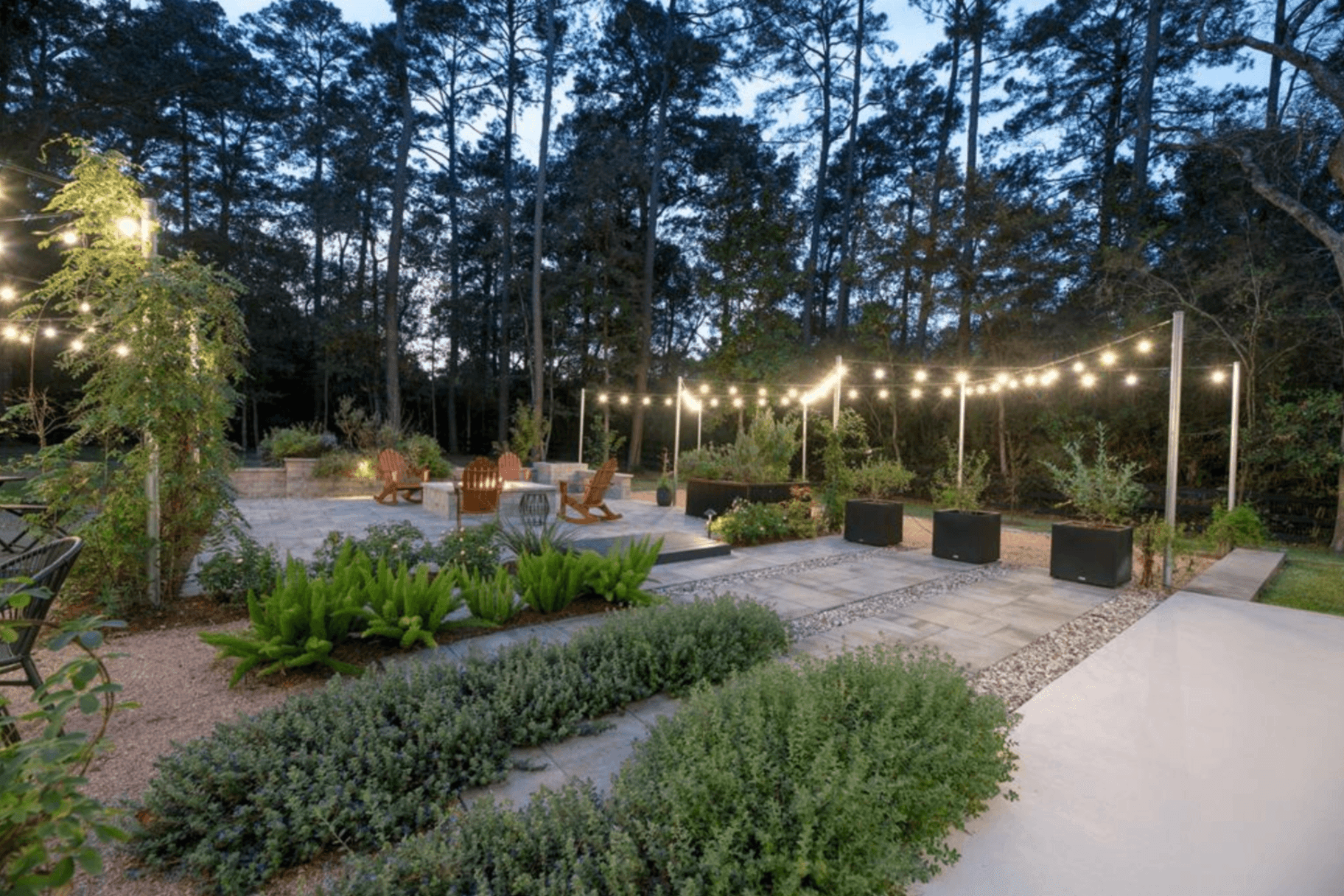
Kingwood calls itself the Livable Forest, and that forest changes the entire geometry of a lighting plan. On a typical village lot the loblolly pines run sixty to eighty feet, water oaks and sweetgums close the canopy overhead, and the ground plane sits in deep shade even at midday. Aiming light upward into that mass mostly illuminates bark and disappears. The systems that work here are built from the top down — fixtures mounted high in the trees, throwing soft light onto the lawn, the drive, and the beds below. Greystone Landscapes has worked Greater Houston since 2005, and Kingwood is the market where we spend the most time on a ladder and the least time staking fixtures in a front bed.

(281) 235-9143

Why here

Why landscape lighting make sense in Kingwood

Landscape lighting in Kingwood does more than look beautiful — it signals a well-maintained, premium property that stands out on the street. Master-planned community homeowners who invest in professional lighting consistently see the impact in curb appeal, security, and the number of evening hours they actually use their outdoor spaces.

01

In Kingwood, Light Comes Down

Moonlighting is the technique the neighborhood was built for. Small shielded fixtures set twenty-five to forty feet up, aimed down through the branch structure, cast the leaf and needle pattern across the ground the way a full moon does through a clear sky. Nobody standing in the yard sees a source. What they see is a dappled, quiet wash over the driveway and lawn, and a house that reads as though it sits in a lit clearing.

The practical advantage is at least as important as the look. Every source is far above eye level, so glare is essentially eliminated, and light arrives on the surfaces people actually use — the walk, the steps, the parking court — rather than on foliage. On a lot with heavy canopy this delivers usable illumination with a fraction of the fixture count an uplight-driven plan would need.

Uplights still have a role, just a smaller one. A specimen water oak with real trunk character earns two or three at the base. Pines mostly do not: a loblolly's interest is a straight bare trunk to sixty feet, and washing that with light produces a bright column and little else. We put pines to work as mounting platforms instead of as subjects.

02

Mounting Thirty Feet Up Without Hurting the Tree

A downlight is only as good as its attachment, and trees are living, moving structures. Fixtures go on stainless hardware sized to the limb, with wire run in loose service loops and secured with insulated staples that hold without biting. Cable never gets wrapped around a branch or trunk. A tight wrap girdles growth, and in a healthy pine that means losing the limb — and the fixture with it — in a few years.

Access planning is part of the design. Every high mount needs a route a technician can reach with a ladder or pole later, because lenses collect pine pollen every spring, aim drifts as limbs load and grow, and LED modules eventually need swapping. We map each fixture's height and access method on the as-built so the sixth-year service call is a routine visit rather than an excavation.

We aim these fixtures at night with the homeowner standing where they will actually experience them: the front door, the kitchen window, the end of the driveway. A downlight two degrees off can either graze a limb beautifully or throw a hard hot spot onto the lawn, and no amount of daytime measuring substitutes for looking at it in the dark.

03

The Long Drive Through the Trees

Kingwood driveways curve, and they curve through timber. That combination is genuinely dark — a driver coming in from Kingwood Drive loses the pavement edge quickly once headlights swing off the line of travel. Canopy downlights spaced along the drive solve it better than anything at ground level, because they light the pavement surface itself instead of putting a row of glowing objects in the driver's eyes.

At the turn-in from the street we add definition at the transition: the mailbox, the address, and the first few feet of the apron. Kingwood addresses are notoriously hard for a delivery driver or an ambulance to find at night among the trees, and a small, well-aimed light on the numerals is one of the highest-value fixtures on the property.

Where a drive passes tight to trunks, we keep fixtures and cable out of the crush zone and off the low limbs a truck mirror will find. Anything within reach of a vehicle door gets moved rather than protected.

04

Greenbelt Edges and the Dark Side of the Lot

A great many Kingwood homes back to a greenbelt or a trail corridor, which is a large part of why people live here and also the darkest boundary on the property. The right treatment is a soft, low edge rather than a floodlit wall. We define the transition from mown lawn to woods with widely spaced, tightly shielded fixtures or with downlights from the first row of trees, so the yard has a visible limit without projecting light into the natural area.

Gates, back walks, and the path from the trail to the patio deserve deliberate attention. These are the routes people use after dark returning from a walk, and they are typically the least lit part of a Kingwood lot. Step risers, grade changes, and the first stair off a deck each want a dedicated source.

Wildlife and neighbors both argue for restraint. Light spilling into a greenbelt disrupts the corridor and does nothing for the homeowner, so every fixture near that boundary is shielded and aimed inward at the property. It also keeps a back yard from becoming the brightest object visible from the trail.

05

Water Has Been Here Before: Wiring for a Flood Plain

Parts of Kingwood, particularly the sections nearest the San Jacinto in Forest Cove and Elm Grove, have taken water. That history changes where we put the components that do not like being submerged. Transformers get mounted high on the wall — well above any documented flood elevation on the property, not merely above the flower bed — and on a face of the house we can reach for service without a ladder.

Below grade, everything is specified as though it will spend time underwater, because it may. Sealed, direct-burial-rated splices rather than wire nuts, generous cable gauge, and connections grouped in accessible locations recorded on the plan so a post-flood inspection is quick. Kingwood's sandy loam drains better than Houston's gumbo clay, but a river event does not care about soil type.

We also keep runs clear of the drainage swales and low routes that carry water off these lots, and out of the areas where a homeowner tells us silt piled up last time. The goal is a system that comes back on after the power does rather than one that needs to be dug up.

06

Cost, Approvals, and Owning a Forest System

Fixture count drives the number more than any other variable. In Kingwood an installed low-voltage fixture typically works out to $250 to $450 with its share of transformer, wire, sealed connections, and labor included. Twelve to twenty fixtures is a normal count for a village lot and lands the project between $4,000 and $9,000. Larger wooded properties with a lit drive, several canopy trees, and greenbelt frontage run $10,000 to $25,000 and higher.

Tree-mounted work carries more labor per fixture than ground-staked work, which is the honest reason a Kingwood quote can exceed a comparable-count quote in a flat, open subdivision. What it buys is durability and effect: fewer fixtures doing more, no glare, and light landing where you use it.

On approvals, Kingwood has sat inside Houston city limits since the 1990s annexation, so the line-voltage circuit feeding a transformer follows the city's electrical permit and inspection process and is done by a licensed electrician. We confirm the current requirement for your scope before pricing. The village associations and the community association also review exterior changes; where a submittal is needed, we put the fixture specifications, finishes, and a location plan together and send it in for you.

Plan on maintenance as part of ownership here. Pine pollen coats lenses each spring, leaf drop shifts what the light hits, and limbs grow into and out of beams. An annual after-dark visit to clean, re-aim, and adjust keeps a forest system looking the way it did the week it went in.

What you get

What Kingwood homeowners get

Low-voltage LED systems with decades of lifespan

Path and step lighting for safety

Uplighting to showcase trees and architecture

Accent lighting for gardens and water features

Smart controls and timer systems

Professional installation with underground wiring

How it works

Your Kingwood project, step by step

01

Property walkthrough and lighting design

02

Fixture and color temperature selection

03

Underground conduit and wire installation

04

Fixture placement, aiming and controller programming

Landscape Lighting across Kingwood

Our crews work throughout Kingwood — including these neighborhoods and the surrounding area.

Kings PointBear BranchElm GroveTrailwoodGreentree VillageForest CoveMills Branch VillageFosters MillWoodland HillsSand Creek

Questions

Landscape Lighting questions from Kingwood homeowners

Request a quote

Ready for landscape lighting at your Kingwood home?

Greystone Landscapes has designed and built outdoor spaces across Greater Houston since 2005. Get a free on-site consultation for your Kingwood project.

(281) 235-9143